Physicians Evolving: Hippocrates 1.0 – 4.0
Medicine has reorganized itself perhaps three times in its recorded history, and we are now inside a fourth.
Medicine has reorganized itself perhaps three times in its recorded history, and we are now inside a fourth.
Exhibit 1.1 sets the four epochs along a single timeline and pairs each physician identity with the prevailing mode of medicine and the locus of care that defined it. The columns move together.
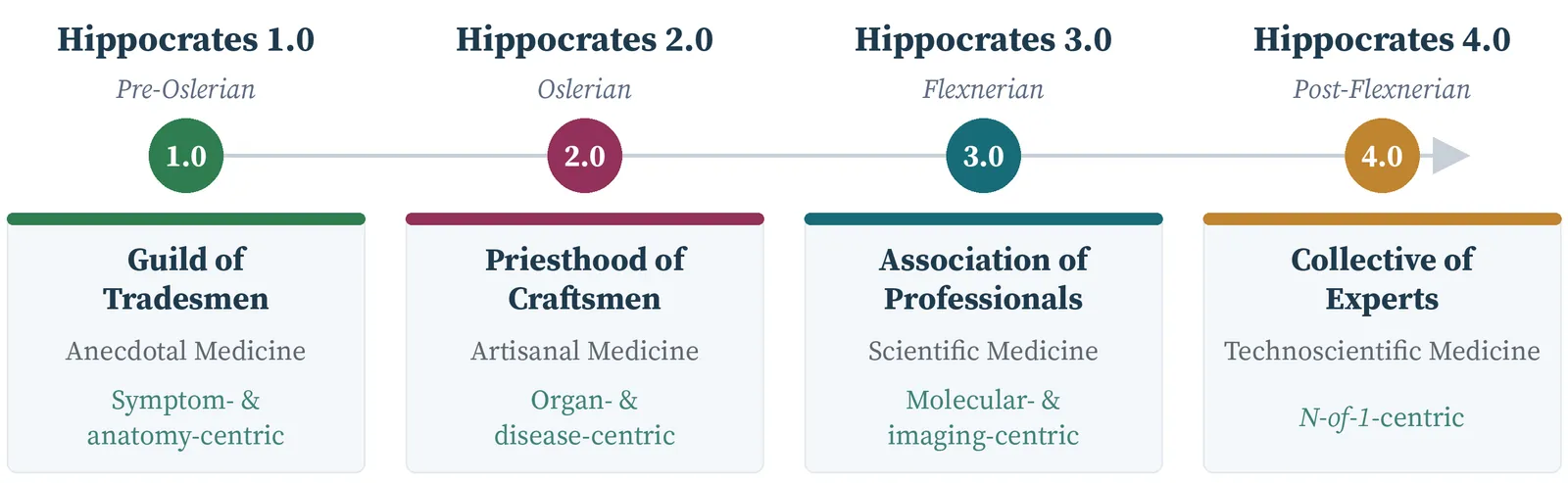
Hippocrates 1.0, the pre-Oslerian epoch, was a guild of tradesmen practicing anecdotal medicine that was symptom- and anatomy-centric. Knowledge passed by apprenticeship, and the body was known chiefly from its surface and its parts.
Hippocrates 2.0, the Oslerian epoch, was a priesthood of craftsmen practicing artisanal medicine that was organ- and disease-centric. Bedside observation became method, and the ward became the classroom.
Hippocrates 3.0, the Flexnerian epoch, produced an association of professionals practicing scientific medicine that was molecular- and imaging-centric. This is the identity that has endured for more than a century, and it remains indispensable.
Hippocrates 4.0, the post-Flexnerian epoch now envisioned, is best understood as a collective of experts practicing technoscientific medicine that is N-of-1-centric. Its defining feature is a new relationship to knowledge, not a new body of knowledge. The physician moves from primary holder of information to its interpreter, synthesizer, and guide within an environment of overwhelming abundance.
Read as a table, that progression looks like an orderly succession. It was nothing of the kind. Each transition was contested, and each was engineered by identifiable people using instruments other than persuasion. Osler's bedside method displaced a guild whose income and authority rested on the didactic lecture and the preceptorship, and it became possible at Hopkins only because Mary Elizabeth Garrett and the Women's Fund Committee attached conditions to the money that opened the school, over the objection of its president.
The Flexnerian settlement was engineered more deliberately still. The American Medical Association had surveyed the schools in 1907 and declined to publish, fearing its own membership, and so commissioned the Carnegie Foundation to say publicly what it would not say itself. The resulting report was enforced through state licensure and financed by philanthropy, and the number of medical schools fell from one hundred sixty-six to seventy-six within two decades. The price was severe and unevenly distributed. Five of the seven Black medical schools were closed, women's and rural schools with them, and the resulting deficit in the physician workforce has still not been repaired. Osler himself resisted the turn that followed, warning against clinical professors whose horizon would end at the laboratory bench.
Identity shifts of this magnitude are engineered, not awaited. They are resisted by those who stand to lose, and, when the engineering is careless, paid for by those with the least standing to object. A fourth transition left to arrive on its own will be designed by someone else, and the profession will learn its terms after they are set.
The modern Flexnerian physician has been steadily disempowered, reduced to a downstream adopter of technologies chosen elsewhere, by procurement committees, by vendors, and by payers.
Hippocrates 4.0 must therefore be re-empowered. The future physician should be equipped to evaluate, validate, and implement new technologies, exercising informed agency over the tools of care.
Informaticists understand these systems more deeply, engineers built them, and regulators are charged with policing them, which leaves the physician's authority over clinical technology in need of a defense. That defense rests on exposure rather than expertise.
Of everyone in the chain that carries a technology from design to bedside, the physician is the only party who must apply it to a particular person, in that person's presence, under uncertainty that no specification resolves, and who can afterward be required to explain why. Accountability of that kind cannot be delegated upstream, and it is the strongest available claim to authority over the tools through which it is incurred. Governance rights should track answerability. Answerability stops at the bedside.
The chapters that follow offer a vision for that emerging physician.
Ideas on this section
No ideas linked here yet. Propose an extension, a counterpoint, or a way to test a claim.
Discussion
Annotate this section — questions, counterpoints, references.
No comments yet. Start the thread.