Global Health Governance, Security, Ethics
Defining the global physician means more than practicing across borders. It means accepting that pathogens, data, and inequities ignore jurisdiction.
Defining the global physician means more than practicing across borders. It means accepting that pathogens, data, and inequities ignore jurisdiction.
Governance
Global health governance is the set of rules, institutions, and processes by which collective health decisions are made and enforced across jurisdictions, and its defining feature is that it is normative without being binding. The International Health Regulations obligate states to detect, report, and respond, yet carry no meaningful enforcement. Authority is fragmented across scores of bodies with no arbiter. Financing is voluntary and earmarked, so agendas follow donors. And the actors with the greatest operational effect, among them pharmaceutical firms, platform companies, philanthropies, and the model developers building the diagnostic tools of the next decade, sit largely outside the formal architecture.
The Pandemic Agreement adopted in May 2025 cannot open for signature until its Pathogen Access and Benefit-Sharing annex is adopted, and the model itself is shifting from multilateral convening toward transactional bilateralism, with new centers of gravity in Africa CDC and in South-South cooperation. The specifics will date quickly; the structural lesson will not. An architecture financed by a handful of voluntary donors and enforced by nobody is fragile by construction.
Elevating governance is therefore the overarching recommendation, and the direction is specifiable even where the mechanism is contested. It runs from voluntary compliance toward obligation; from fragmented vertical initiatives toward pooled, predictable financing that funds systems, not diseases; from a state-only membership model toward one bringing consequential non-state actors inside the accountability structure; and from episodic mobilization toward standing capability, with surveillance, manufacturing, and workforce treated as infrastructure.
The physician's contribution here is evidentiary and professional, not diplomatic. Governance failures are visible first at the point of care, in a stockout, a delayed notification, a tool never validated locally, and the clinical community is the one constituency present in every jurisdiction, credible with the public, and not paid by the actors being governed.
Security
Health security has moved from a specialist concern to a central one, and the current threats rank in rough order of consequence.
Zoonotic and pandemic viral infection is widely regarded as the leading threat, The distinctive feature of the present moment is the contraction of surveillance and response capacity when it is most needed, and a blind spot lengthens the interval between spillover and recognition.
Antimicrobial resistance, the slow pandemic, associated with millions of deaths annually, is the clearest collective-action failure inside clinical medicine itself, each prescribing decision locally defensible and the aggregate catastrophic. It is the population-scale analogue of the adaptive-therapy logic of Chapter IX, an evolutionary problem in which steering outperforms maximal force.
Disease X and novel spillover will most likely emerge from one of the roughly two dozen viral families already known to infect humans, driven by land-use change and the wildlife interface, which is the One Health frame arriving as a security problem. Biosecurity, dual-use, and AI-enabled biothreats return the argument of Chapter IV to a global frame, since the same generative capability that designs a therapeutic protein can design a harmful one.
Eroding trust, vaccine hesitancy, and the infodemic are now core security variables, and this is the item clinicians influence most directly. And health in conflict and fragile settings creates humanitarian catastrophe and reservoirs for uncontrolled outbreaks simultaneously. Physicians are not the primary governors of most of these boundaries. However, they are among the few practitioners who will meet both sides of them.
Ethics
Global health ethics covers a broad range of issues, and some are illustrative.
Take the ethics of abrupt withdrawal, a concern is immediate. When programs keeping millions alive are discontinued at short notice, the questions are concrete: what duty of continuity is owed to a patient begun on lifelong therapy; what harm was foreseeable; and how residual capacity should be prioritized. The underlying principle is one clinicians already hold, that initiating a treatment creates an obligation which does not lapse when funding does.
Extending global health, is central equity considerations. Persistent asymmetries between wealthy actors and Global South counterparts have produced paternalism, unequal resource-sharing, and skewed benefit, and instruments such as the TRUST Code, together with the practical relocation of leadership, funding, and authorship, define the response. Physicians can address this one concretely, through the partnerships they enter and the terms they accept.
Pathogen access and benefit-sharing justice crystallizes a genuine dilemma beneath what is usually reported as procedural delay: sovereignty over samples and sequence data against the world's need for rapid sharing, given a history in which materials moved north and the resulting products did not move back. Data and sample sovereignty extends the problem to models trained on Global South populations but owned and commercialized elsewhere, driving demands for community data governance and now for cognitive sovereignty, the claim that a community should govern the epistemic logic of the systems that analyze its data, and not only the data itself.
Aid conditionality raises the ethics of trading on desperate need against sovereign health decisions, and allocation and rationing justice enter the discourse. Alongside these sit heritable genome editing, intergenerational justice, and the governance of AI deployed in settings that had no part in its design.
Governance, Security and Ethics Interwoven
These three domains are collapsing into one. Governance disconnects are producing security gaps, and security gaps, along with coercive bilateral arrangements, are generating ethical dilemmas. They can no longer be addressed by different people in different rooms, which is why the socially responsible physician described at the opening of this chapter is now asked to operate across all three at once instead of choosing a lane.67
In Chapter II, editing the germline, deciphering the brain, extending lifespan, and conquering space were presented as four frontier ambitions, each transformative and each ethically double-edged in a way that must be addressed earlier rather than later: heritable modification alters people who cannot consent; a device that reads intention can infer thought; purchasable healthspan converts existing inequality into biological inequality.
The global corollary follows, since that task cannot be discharged jurisdiction by jurisdiction. A heritable edit performed anywhere enters the human germline everywhere, and the descendants of that decision are not citizens of the country that permitted it. A longevity therapy available in three wealthy markets produces a global inequality on a biological substrate that no subsequent redistribution reverses. The double edge is shared even when the decision is not.
Eclectic governance is itself a complication. If a small number of countries deliberate carefully while others do not regulate at all, the effective global standard is set by the most permissive jurisdiction. The 2018 germline editing episode demonstrated the mechanism precisely: national frameworks existed, and the constraint that actually operated was a single researcher's judgment in a setting where enforcement did not reach. Regulatory arbitrage is the default equilibrium of frontier biotechnology, and only international governance would change that.
The governance deficit is a problem for every frontier technology this report describes, and the frontier is arriving ever faster. The physician who understands the science well enough to judge what is being claimed, and who is answerable to patients, is the participant best positioned to insist that these decisions be taken collectively. That is the global expression of the bioethical fluency Chapter II identified as a core competency rather than a service procured after the design is fixed.
Insisting is only meaningful if there is a mechanism, and a profession holds different levers from a state. Several are real. Refusal to participate, since procedures no qualified clinician will perform will not happen at scale, no matter what a given jurisdiction permits. This is what made the response to the germline episode consequential. Publication and disclosure norms, since journals and societies decide whether work conducted outside agreed standards can be reported, cited, and built upon, and unpublishable work is largely unfunded work.
International specialty standards that travel with the practitioner instead of with the jurisdiction, so that a certification carries obligations that do not lapse at a border. And the ordinary machinery of professional consequence, which runs through societies, registries, and appointment committees rather than through treaties. None of these substitutes for binding international law. All of them are available now, and they are what the profession actually holds.
The individual physician can engage this work at more levels than is generally appreciated, and the useful framing is a ladder rather than a binary between going abroad and staying home.
- Direct clinical service and workforce: humanitarian and outbreak deployment, task-sharing, and long-term placement under a bidirectional arrangement.
- Research through equitable partnership, with leadership, authorship, and data governance located in the countries concerned, and implementation science in particular, aimed at the knowledge-to-population gap with which this chapter opened.
- Health systems strengthening and policy: advising ministries, designing universal coverage and primary care, and building the domestic-financing capacity that the contraction in development assistance now demands.
- Field epidemiology and outbreak response, the operational expression of the security agenda above.
- Education and capacity-building, including South-South exchange, aimed at decentring Northern institutions as sole knowledge producers.
- Advocacy and health diplomacy, bringing a clinical voice to multilateral and national fora: the chapter's opening tradition applied globally.
- Governance and multilateral leadership, and technical standard-setting, where the substantive rules are written and clinicians are scarcest.
- Innovation, manufacturing, and financing: digital health and AI, diagnostics and vaccine science, regional manufacturing sovereignty, and the blended-finance and social-enterprise models now asked to fill gaps that public aid has vacated.
Climate Change and Health: A Case in Point
Global threats that are broadly encompassing and not centered in the health sphere per se also enter the arena. Some of these are existential for humanity, with a definable global health stream. And as suggested in the prior section, for them, governance, security, and ethics are interlaced. Climate change is a case in point.
Some have suggested that climate change may prove to be the defining global health challenge as this century unfolds. It has surfaced already in the population health frontiers discussion of this chapter, in the moonshot that treats planetary stewardship as clinical work, and in the observation that systems built now can be adapted to the anticipated conditions of 2050 instead of retrofitted from those of 1970.
Taken as a single case it exercises all three domains at once. The governance question is that health consequences cross every border while the instruments for addressing them bind no one in particular. The security question is that the same events which generate clinical demand degrade the facilities, supply chains, and workforce meant to meet it, and that displacement, food insecurity, and water insecurity have their own epidemiology. The ethical question is distributional, since exposure and vulnerability track age, income, comorbidity, occupation, housing, and geography to a great extent. This means the populations least equipped to absorb the harm receive most of it.
The health effects are measurable rather than prospective, and they are already arriving in clinics. The Lancet Countdown, now in its ninth annual edition and drawing on more than a hundred experts across dozens of institutions, reported that twelve of its twenty health-risk indicators reached record levels. Heat-related mortality has risen by roughly sixty-three percent since the 1990s to approach 550,000 deaths a year, and extreme heat exposure cost an estimated 640 billion labor hours in 2024. The World Health Organization's deliberately conservative assessment projected some 250,000 additional deaths annually between 2030 and 2050 from malnutrition, malaria, diarrheal disease, and heat stress alone, a partial estimate that omits most displacement and conflict pathways and is better seen as a floor.
This gets quite granular at the bedside. Heat interacts with ordinary prescribing, with diuretics, anticholinergics, antipsychotics, and beta-blockers, and with cardiac, renal, and psychiatric illness. Expanding climatic suitability for dengue, malaria, Vibrio, and tick-borne infection shifts the differential diagnosis in temperate regions where physicians trained on a narrower geographic range. Wildfire smoke and air quality drive cardiorespiratory presentations. Floods interrupt medication and dialysis, damage facilities, and leave durable increases in anxiety, depression, and post-traumatic stress. Recognizing and managing this cluster is competent care under changed conditions, which places it inside existing scope of practice and makes it the least contestable of the physician's roles here.68
Beyond the bedside, the profession holds an asset it has been slow to spend. Physicians rank among the most trusted messengers on this subject, including with audiences that discount climate scientists, and framing the matter as a health question rather than an environmental or political one shifts public engagement in ways other framings do not. A multinational survey of some 4,650 health professionals drawn from twelve organizations across all six WHO regions found that respondents broadly accepted the health case and considered advocacy appropriate, then reported time, insufficient knowledge, and low confidence in their own standing as the barriers that stopped them.
The professional bodies have supplied the policy: the American College of Physicians converted the public-health argument into a position addressed to individual clinicians, asking them to support adaptation, to attend to environmental determinants in their own practice, and to educate patients, colleagues, communities, and lawmakers. Population-level attribution of heat mortality, rather than controversies over the genesis of climate change, is the better path for the physician and is what is worth communicating.69
The precedent for what physicians can accomplish on a threat of this scale is the one that opened this chapter. Bernard Lown and Evgeni Chazov built International Physicians for the Prevention of Nuclear War across the Cold War divide by declining to argue as partisans and insisting instead on describing, in clinical terms, what the exposure would do to human bodies. Lown's own account of that work records how much of its authority came from method rather than moral urgency: identify the exposure, quantify the dose, describe the outcome, act on the cause, and keep the organization broad enough that physicians who agreed on nothing else could agree on the finding.
Climate and health is the successor cause, and the same method applies to it, which is why the Countdown's indicator-by-indicator discipline matters more than any single alarming total. What the profession lacks is not the standing or the evidence but the formation. Physicians report that they were never taught this material, cannot judge what falls within their competence, and have no time carved out to acquire either. That is a claim on medical education.70
Threats to Planetary Health
Lown's cause opened this chapter, and climate change occupied the preceding section, but the planetary threats that fall within the physician's domain are not limited to those two. Exhibit 10.2 brings together four of them in a composite picture. Nuclear weapons, biological weapons, climate change, and artificial intelligence occupy one quadrant each, and every quadrant reads outward through the same four categories: mass casualty burden; health system disruption; long-term disease and mental health; and equity, food, and displacement. The concentric arrangement is deliberate. Whatever the source, the harm arrives as morbidity and mortality at a scale treatment cannot meet, and a profession organized around prevention owns what it cannot treat.
As alluded to already, nuclear weapons are the founding case. The 1962 Boston study that launched Physicians for Social Responsibility counted burn beds and surviving physicians and found that a single thermonuclear attack would exhaust both: casualties beyond any capacity, with the hospitals and clinicians meant to respond among the first losses. Two findings have been added since. Radiation malignancy, the leukemias and myelodysplastic syndromes that Nagasaki hematologists followed in hibakusha for more than fifty years, is the portion of nuclear harm measured in clinics rather than modeled. Nuclear famine is the larger: soot from burning cities lofted into the stratosphere would depress staple crop yields for years, and a regional exchange involving a small fraction of the world arsenal places some two billion people at risk of starvation, which gives every non-nuclear state a direct stake in the outcome. In 2023 an identical editorial in more than a hundred medical journals carried these findings to the nuclear-armed states, demanding no-first-use, de-alerting, and verifiable elimination; the prospective fusion of machine-speed decision support with nuclear command and control, which the physicians' federation has since named a new category of risk, extends the case.71
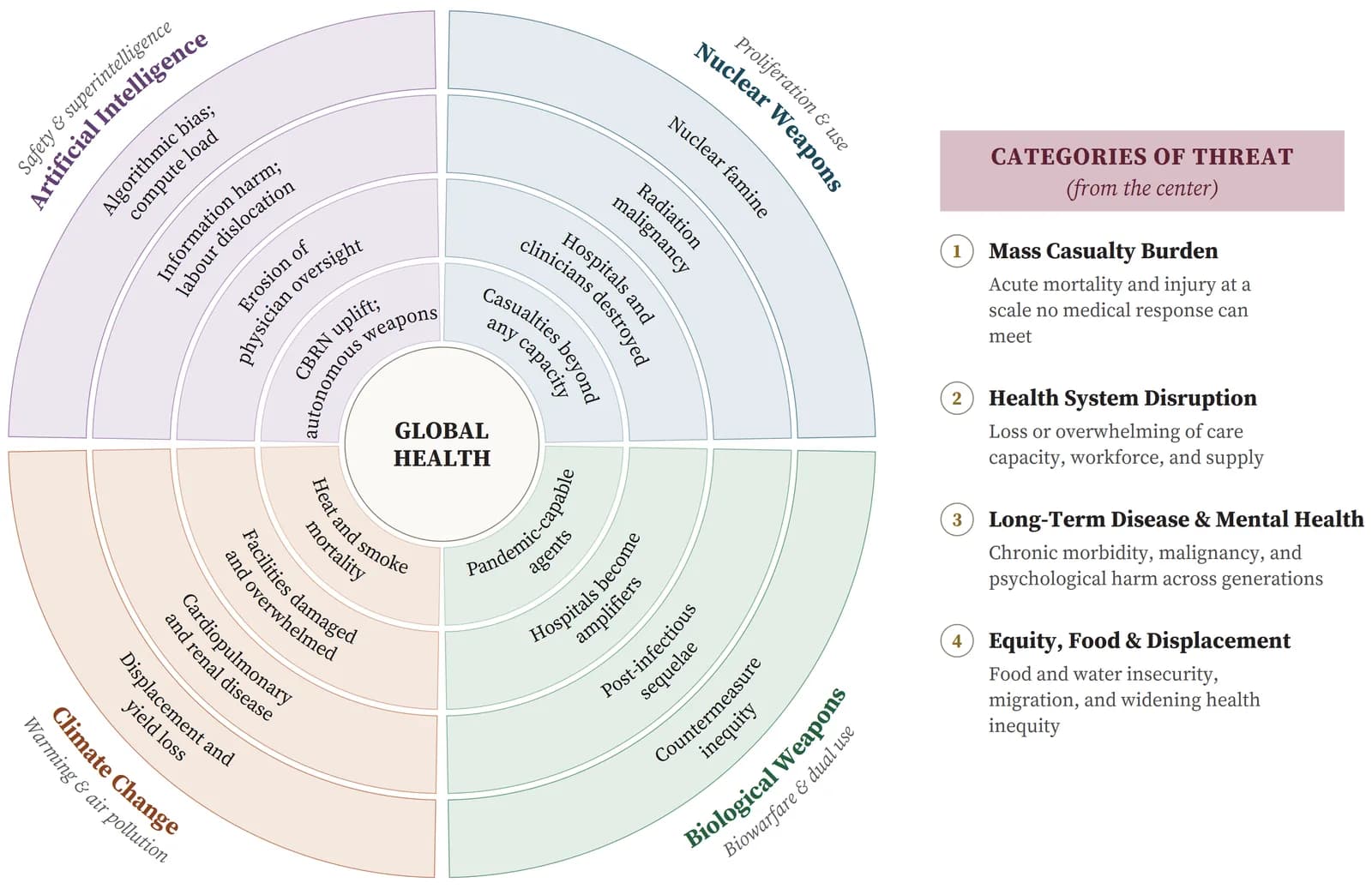
Biological weapons place the profession where no other threat does. Every offensive program in the historical record was staffed by physicians and biomedical scientists, which makes medicine the gatekeeper of the capability and not only a witness to its use. Pandemic-capable agents are the mass casualty case, and hospitals become amplifiers rather than refuges, as SARS in 2003 and the first months of COVID-19 each showed. Post-infectious sequelae carry the burden across years, and countermeasure inequity, the allocation of vaccines and antivirals by purchasing power, decides who bears it. The Biological Weapons Convention has had no verification mechanism since it entered into force in 1975, so the regime rests on professional norms, codes of conduct, and scientist self-governance, ground the medical associations already hold. The JAMA consensus statements on smallpox, anthrax, and plague made a physician-founded center the clinical reference standard for the field. The same center now speaks to the convergence of frontier AI with biological design tools and argues for mandatory screening of nucleic acid synthesis orders, since a model that lowers the expertise barrier to reconstructing a pathogen is a biosecurity hazard whatever else it is.72
Climate change, treated at length in the preceding section, sits in the same frame. Heat and smoke mortality is the acute burden: heat-related deaths have risen by roughly sixty-three percent since the 1990s, and twelve of the Countdown's twenty health-risk indicators reached record values. Cardiopulmonary and renal disease under thermal stress, and the interaction of heat with diuretics, anticholinergics, and beta-blockers, is the long-term burden arriving in ordinary practice. Facilities damaged and overwhelmed by flood and fire are the system disruption, and displacement and yield loss carry the equity burden to the populations least able to absorb it. Notably, physicians rank among the most trusted messengers on the subject, and the barriers they report are time, knowledge, and confidence in their standing rather than doubt about the evidence.73
Artificial intelligence is the least developed of the four threats and the one where the analogy to 1961 is perhaps most compelling. The risk is being characterized by the technologists who create it, with the profession largely absent from the framing. The near pathways are concrete. CBRN (Chemical, Biological, Radiological, and Nuclear) uplift, the lowering of the expertise barrier to CBRN harm, and autonomous weapons that remove human judgment from the decision to kill sit at the center. Erosion of physician oversight, the subject of the World Medical Association's 2025 physician-in-the-loop statement, is the system disruption. Information harm and labor dislocation act through the social determinants; algorithmic bias and the energy and water load of frontier compute widen inequity and feed the climate quadrant.
Beyond these lies misalignment: a system of human-level or greater general capacity that learns and self-improves may pursue objectives its designers did not intend and cannot correct.74 The probability of existential catastrophe from artificial superintelligence, written p(doom) and descended from Nick Bostrom's Superintelligence, has entered the lexicon, albeit the percentage number remains highly contested. A 2023 survey of 2,778 published AI researchers returned a median of five percent for outcomes as bad as human extinction, with between a third and a half of respondents at ten percent or more, and individual estimates from prominent researchers span the whole interval. No casualty model, no burden-of-disease estimate, and no physician federation yet exists for this hazard, and the physician-authored analyses that have framed it as a public health threat carry the nuclear-prevention movement's authorship and its precedent.75
The four threats converge, and the convergences are mechanistic. AI-enabled biological design links the machine quadrant to the pathogen; AI in nuclear command and control links it to the warhead; the energy demand of frontier compute links it to the climate; and nuclear winter is a climate mechanism. Beneath the linkages are the features the threats share. In each, the harm exceeds any conceivable treatment capacity, so the only available intervention is primary prevention, a clinical argument that non-clinicians cannot make with equal force. In each, authority has come from something a physician saw or counted: burn beds in Boston, leukemia in Nagasaki, contaminated emergency staff in Tokyo, worsening asthma in a family practice. In each, the profession is a participant and not only a witness: physicians staffed Unit 731 and are deploying AI into clinical care now. And the interval between a hazard's arrival and the profession's mobilization has shortened, from sixteen years for nuclear weapons to a matter of months for AI, while the window for prevention has narrowed with it. Lown's template of reframe, quantify, testify, and prescribe transfers across all four, and the formation of the physician of 2050 has to be built to address it.
Notes
- 67Calvin W. Schwabe, Veterinary Medicine and Human Health (Baltimore: Williams & Wilkins, 1964); Wildlife Conservation Society, the Manhattan Principles on "One World, One Health" (2004); Sarah Whitmee, Andy Haines, et al., "Safeguarding human health in the Anthropocene epoch," The Lancet 386 (2015): 1973--2028. On the current architecture: U.S. Department of Health and Human Services and Department of State, announcement of completed U.S. withdrawal from the World Health Organization, 22 January 2026; WHO Pandemic Agreement, adopted by the Seventy-eighth World Health Assembly, 20 May 2025, with Pathogen Access and Benefit-Sharing annex under negotiation by the Intergovernmental Working Group through 2026; International Health Regulations (2024 amendments), in force 19 September 2025. These are fast-moving matters, and figures and status should be checked against current sources.
- 68Marina Romanello, Maria Walawender, Shih-Che Hsu, et al., “The 2025 report of the Lancet Countdown on health and climate change: climate change action offers a lifeline,” The Lancet 406, no. 10521 (2025): 2804–2857, the source of the heat-mortality, labour-hour, and indicator figures cited here; the series is re-estimated annually with revised methods, so any quantitative claim should be checked against the current edition rather than against a remembered number. World Health Organization, Quantitative Risk Assessment of the Effects of Climate Change on Selected Causes of Death, 2030s and 2050s (Geneva: WHO, 2014), for the 250,000-deaths projection, which the report itself presents as partial. Anthony Costello, Mustafa Abbas, Adriana Allen, et al., “Managing the health effects of climate change,” The Lancet 373, no. 9676 (2009): 1693–1733, and Nick Watts, W. Neil Adger, Paolo Agnolucci, et al., “Health and climate change: policy responses to protect public health,” The Lancet 386, no. 10006 (2015): 1861–1914, the two UCL–Lancet Commissions that framed the field and the direct parents of the Countdown; Caren G. Solomon and Regina C. LaRocque, “Climate change—a health emergency,” New England Journal of Medicine 380, no. 3 (2019): 209–211.
- 69John Kotcher, Edward Maibach, Jeni Miller, et al., “Views of health professionals on climate change and health: a multinational survey study,” The Lancet Planetary Health 5, no. 5 (2021): e316–e323, the source of both the trusted-messenger finding and the three reported barriers; Ryan A. Crowley, for the Health and Public Policy Committee of the American College of Physicians, “Climate change and health: a position paper of the American College of Physicians,” Annals of Internal Medicine 164, no. 9 (2016): 608–610, extended by Ryan Crowley, Sue Mathew, and David Hilden, “Environmental health: a position paper from the American College of Physicians,” Annals of Internal Medicine 175, no. 11 (2022): 1591–1593; Edward Xie, Enrique Falceto de Barros, Alan Abelsohn, Airton Tetelbom Stein, and Andy Haines, “Challenges and opportunities in planetary health for primary care providers,” The Lancet Planetary Health 2, no. 5 (2018): e185–e187, for what the agenda looks like inside a single consultation. The advocacy role is contested within the profession, on the argument that political engagement risks the very trust that makes physicians effective messengers; the objection is a serious one and is not merely partisan.
- 70Bernard Lown, Prescription for Survival: A Doctor’s Journey to End Nuclear Madness (San Francisco: Berrett-Koehler, 2008), Lown’s own account of the founding and method of International Physicians for the Prevention of Nuclear War; see note 62 above for the Virchow–Lown lineage. Much of the literature on the physician’s role in this area is high-income and Anglophone while the harms fall most heavily elsewhere; the Countdown’s regional reports partly correct for this and are the better starting point for any non-US or non-UK application.
- 71Frank R. Ervin, John B. Glazier, Saul Aronow, et al., “Human and ecologic effects in Massachusetts of an assumed thermonuclear attack on the United States,” New England Journal of Medicine 266, no. 22 (1962): 1127–1137, with Victor W. Sidel, H. Jack Geiger, and Bernard Lown, “The medical consequences of thermonuclear war. II. The physician’s role in the post-attack period,” New England Journal of Medicine 266, no. 22 (1962): 1137–1145, the Boston casualty study from which Physicians for Social Responsibility grew; Lili Xia, Alan Robock, Kim Scherrer, et al., “Global food insecurity and famine from reduced crop, marine fishery and livestock production due to climate disruption from nuclear war soot injection,” Nature Food 3, no. 8 (2022): 586–596, the source of the two-billion figure; Kamran Abbasi, Parveen Ali, Virginia Barbour, et al., “Reducing the risks of nuclear war—the role of health professionals,” BMJ 382 (2023): p1682, published simultaneously in more than a hundred journals, with authors drawn from the editors of the BMJ, The Lancet, JAMA, and the New England Journal of Medicine and from International Physicians for the Prevention of Nuclear War, whose position on artificial intelligence in nuclear command and control is set out at ippnw.org/ai.
- 72Donald A. Henderson, Thomas V. Inglesby, John G. Bartlett, et al., “Smallpox as a biological weapon: medical and public health management,” JAMA 281, no. 22 (1999): 2127–2137, the first of the Working Group on Civilian Biodefense consensus statements, followed by companion statements on anthrax, plague, botulinum toxin, and tularemia through 2001; British Medical Association, Biotechnology, Weapons and Humanity (Amsterdam: Harwood Academic Publishers, 1999), and its 2004 sequel, which drew a formal United Kingdom government response; Jaspreet Pannu, Sarah Gebauer, Greg McKelvey Jr., Anita Cicero, and Tom Inglesby, “AI could pose pandemic-scale biosecurity risks. Here’s how to make it safer,” Nature 635 (2024): 808–811, for the convergence of frontier models with biological design tools and the case for nucleic acid synthesis screening.
- 73Marina Romanello, Maria Walawender, Shih-Che Hsu, et al., “The 2025 report of the Lancet Countdown on health and climate change: climate change action offers a lifeline,” The Lancet 406, no. 10521 (2025): 2804–2857, for the heat-mortality and indicator figures and for the health sector’s own emissions; John Kotcher, Edward Maibach, Jeni Miller, et al., “Views of health professionals on climate change and health: a multinational survey study,” The Lancet Planetary Health 5, no. 5 (2021): e316–e323, for the trusted-messenger finding and the reported barriers; both cited in full at notes 68 and 69 above.
- 74Frederik Federspiel, Ruth Mitchell, Asha Asokan, Carlos Umaña, and David McCoy, “Threats by artificial intelligence to human health and human existence,” BMJ Global Health 8, no. 5 (2023): e010435, which sets out three pathways of misuse and then treats self-improving artificial general intelligence as an existential threat in its own right, with an author drawn from the co-presidency of International Physicians for the Prevention of Nuclear War; Richard C. Armitage, “Artificial general intelligence and its threat to public health,” Journal of Evaluation in Clinical Practice 31, no. 6 (2025): e70269, which divides the threat into misuse and misalignment and invokes the 1985 Nobel Peace Prize as the explicit precedent; World Medical Association, Statement on Artificial and Augmented Intelligence in Medical Care, adopted at the 76th General Assembly, Porto, October 2025, for the physician-in-the-loop principle.
- 75Nick Bostrom, Superintelligence: Paths, Dangers, Strategies (Oxford: Oxford University Press, 2014); Katja Grace, Julia Fabienne Sandkühler, Harlan Stewart, et al., “Thousands of AI authors on the future of AI,” Journal of Artificial Intelligence Research 84 (2025), the survey of 2,778 researchers published in top-tier AI venues, conducted in October 2023, from which the five percent median and the ten-percent-or-more share are drawn. The estimate is contested on every side: the survey’s own authors report substantial disagreement and uncertainty among respondents, critics regard any point estimate for an unprecedented event as unfounded, and published figures from individual researchers range from negligible to a majority. The report takes no position on the number; the relevant finding is that no health-sector quantification of the hazard exists at all.
Ideas on this section
No ideas linked here yet. Propose an extension, a counterpoint, or a way to test a claim.
Discussion
Annotate this section — questions, counterpoints, references.
No comments yet. Start the thread.