Population Health Frontier
The terrain on which that the physician’s obligation is exercised narrows here to the medical and healthcare dimension: the drivers of health that clinical medicine and health systems can readily reach, and the developments at their frontier.
The terrain on which that the physician’s obligation is exercised narrows here to the medical and healthcare dimension: the drivers of health that clinical medicine and health systems can readily reach, and the developments at their frontier.
This can be thought of conceptually. Geoffrey Rose's Sick Individuals and Sick Populations (1985) observed that epidemiology conflates two different questions: why do some individuals have this disease, a question about the causes of cases; and why does this population have so much more of the disease than that one, a question about the causes of incidence. The answers need not be the same and confusing them is where prevention can go wrong.
The high-risk strategy screens out those at greatest risk and intervenes on them. While this is clinically intuitive, it is subject to a fatal ceiling, since most cases arise from the large mass at moderate risk, not the small tail at high risk. The population strategy shifts the whole distribution a little and prevents far more cases, at the cost of the prevention paradox: a measure delivering large benefit to the community offers little to each participant. Training makes the high-risk strategy reflexive; the greater gain lies in the distribution.
Medicine knows, with reasonable confidence, what constitutes best practice for an individual patient. It knows far less about how to deliver that knowledge across a population, and the distance between the two is one of kind rather than a matter of effort or funding.
An intervention validated in a trial has been shown to work in selected patients under supervised conditions. Deploying it across a population means contending with heterogeneous risk, differential uptake, competing priorities, and the fact that those who most need an intervention are too often systematically least likely to receive it. These constitute the efficacy-to-effectiveness gap (the difference between how well an intervention works in idealized conditions versus how well it works in ordinary care) and the inverse care law (the observation that good medical care tends to be least available where the need is greatest). Chapter V described the pursuit of N-of-1 precision at the individual level. The population frontier is the mirrored problem: how to make what is already known reach everyone with the same reliability.
Rose’s analysis can be reconciled with the N-of-1 argument of Chapter V by recognizing that they answer different questions. Population strategy addresses the causes of incidence, which are properties of a distribution and are moved by measures no individual would notice. N-of-1 reasoning addresses the causes of cases, which are properties of a person and are settled by what is true of them in particular.
The physician moves between the two according to which question is being asked. The discipline is in noticing that a measure justified at one level may be unjustifiable at the other: a small average benefit that vindicates a population policy may be the wrong recommendation for the patient in the room, and a treatment correct for that patient may be indefensible as a policy. Confusing the levels produces the physician who prescribes population advice to an individual and the policymaker who generalizes from a vivid case.
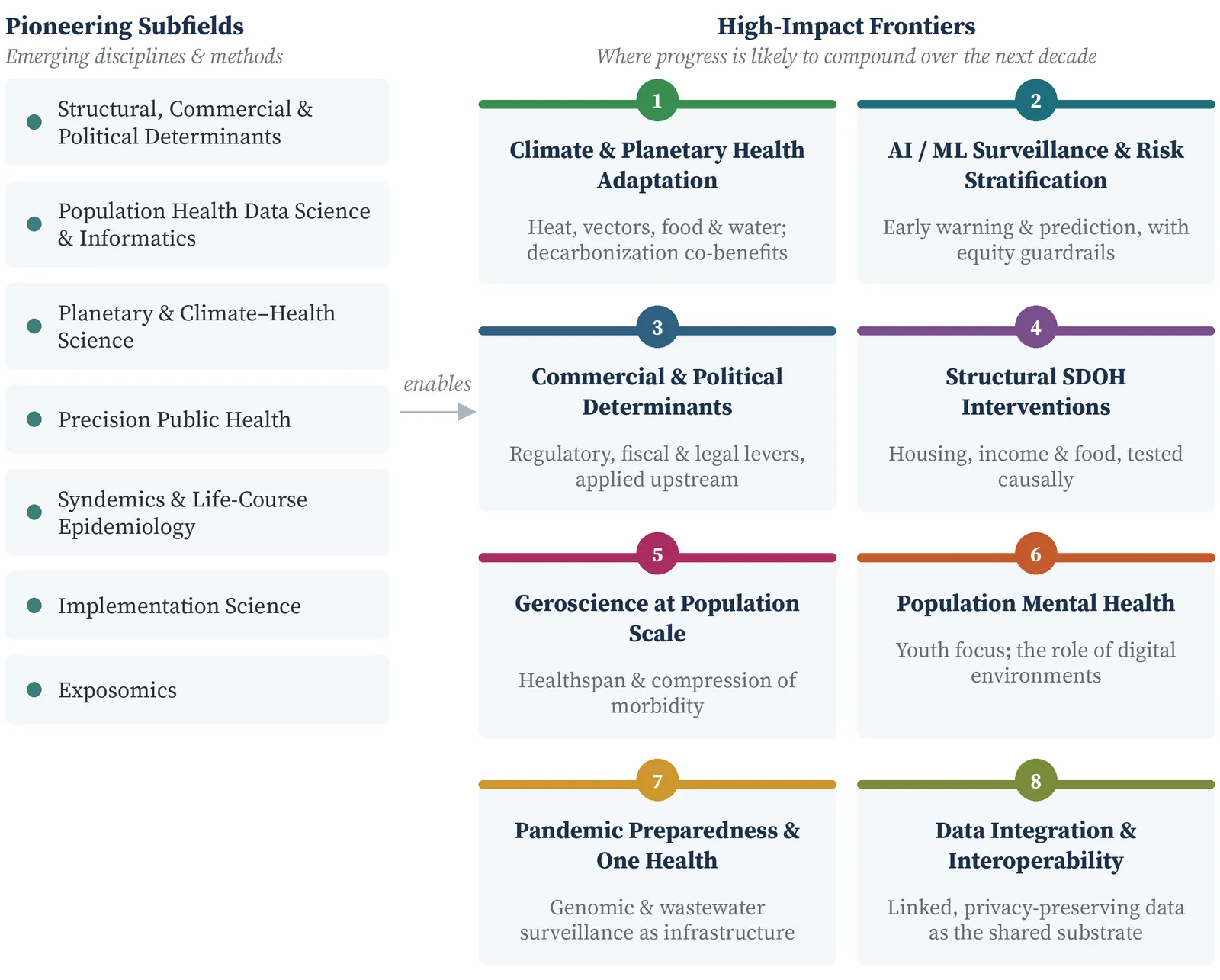
Exhibit 10.1 divides the terrain into pioneering subfields and high-impact frontiers. The pioneering subfields mark where the field's frontier has shifted decisively upstream, away from proximate risk factors and toward the structures that generate them.
They comprise structural, commercial, and political determinants; precision public health, integrating multi-omics with environmental and social data to target subpopulations; and exposomics, the attempt to characterize the totality of environmental exposure across a life course as the genome characterizes inheritance. Alongside these sit planetary and climate-health science; population health data science, spanning linked administrative data, agent-based modeling, and digital epidemiology; syndemics and life-course epidemiology, studying how conditions cluster and interact across time; and implementation science, now a formal discipline in its own right.
Two of the eight high-impact frontiers stand out in the context of this report’s areas of emphasis. AI and machine-learning surveillance and risk stratification is continuous with Chapter IV, and the ecosystem described there reappears at population scale, as do its limits. Pattern recognition is not understanding, and a risk score is a claim about a class rather than a person. The specific population-scale hazard is that a model trained where care is plentiful learns the pattern of utilization, not of disease, then allocates resources to those already receiving them. That makes equity guardrails a technical requirement of the modeling, not an ethical addendum to it.
And data integration and interoperability is the substrate on which the others depend and the limiting factor on all of them. It is a curation problem, not a procurement one, since volume without provenance and harmonization produces confident population models with no defensible relationship to reality.
The remaining six can be stated more briefly. Climate and planetary health are described more fully later in this chapter. Commercial and political determinants apply regulatory, fiscal, and legal levers upstream, and routinely outperform clinical interventions on cost per life-year. Structural interventions on the social determinants, among them housing, income, and food, must be tested causally rather than assumed, since the field's credibility depends on meeting the evidentiary standard demanded of a drug.
Geroscience at population scale aims at healthspan and the alleviation of morbidity instead of at diseases sequentially, which is the population expression of the shift from repair to preemption in Chapter V. Population mental health confronts an exposure that is ambient, a dose difficult to characterize, and an affected cohort least able to consent to the experiment. And pandemic preparedness and One Health turn on treating genomic and wastewater surveillance as permanent infrastructure rather than emergency mobilization.
Two of the report's governing motifs are visible across this list. Complexity, in the sense developed in Chapters IV and IX: a population is a complex adaptive system, so interventions produce nonlinear and sometimes paradoxical effects, and the points that move a system sit far from where symptoms appear. The syndemic framing, of interacting disease clusters coupled to social conditions, is the population-scale statement of the point, and it explains why single-node interventions are so reliably absorbed by the system they target.
And convergence: not one of these eight frontiers belongs to a single discipline. Climate adaptation requires epidemiology, engineering, and economics, AI surveillance requires machine learning, ethics, and law, and structural intervention requires econometrics and political science. The frontier of population health is by construction transdisciplinary. The consilient physician of Chapter VIII and the global physician described here are therefore the same person viewed from two angles.
The Social Engineer
The phrase names a strand within the social-medicine tradition, and one that has become controversial of late. The physician qua social engineer represents a step beyond the socially responsible physician.
It begins with Virchow and runs through Salomon Neumann and the French médecine sociale movement of the same 1848 moment, Alfred Grotjahn's social pathology, and Henry Sigerist, who at Johns Hopkins framed medical education and practice themselves as instruments of social reform. A parallel British stream produced Thomas McKeown and Rose's population strategy. The engineering metaphor surfaces explicitly with René Dubos, who argued that because tuberculosis was produced by social forces, it demanded social remedies. The through-line is a physician who reads a patient's illness as a symptom of the social order, and Virchow's prescriptions were democratic and redistributive. He wanted to empower the poor and not manage them.
The Shadow
That population-level logic represents a significant extension as it tips into the sociopolitical realm. A biological conception of the population transitions into a social one, and coercion enters in place of persuasion. This relates, uncomfortably, to the notion of social medicine, which grew in the same soil at the same time. Applied to human biology, it became eugenics, and physicians were central: compulsory sterilization upheld in Buck v. Bell (1927), and tens of thousands sterilized as unfit.
Nazi medicine is the terminus of that logic, and Robert Jay Lifton's The Nazi Doctors (1986) remains its essential analysis. Its central concept is the biomedical vision: a state imagined as an organism containing diseased cells threatening the life of the whole, within which killing could be rationalized as treatment. Its psychological mechanism is doubling, the formation of a second coherent self able to act against the physician's prior ethics. The point is not historical piety. It is that the profession's most defensible impulse and its most catastrophic failure share a starting premise, and what separates them is whether the population is conceived as citizens to be served or as an organism to be purified.63
Which is why the mainstream movement chose a different word. Physicians for Social Responsibility describes its members as advocates contributing a health voice to policy; the AMA's Declaration of Professional Responsibility exhorts physicians to advocate for changes that ameliorate suffering; and Canada's CanMEDS framework makes health advocate a formal competency. The distinction is substantive, not semantic. Advocate positions the physician as one voice pressing a democratic process, whereas engineer implies steering the population directly.
The contemporary dissent is serious. Thomas Huddle's 2011 argument in Academic Medicine holds that political advocacy is not a core professional responsibility, since civic virtues lie outside professional duty and medicine ought not require a particular political stance of its members. The underlying worry is real. Once health is defined broadly enough to encompass wages, housing, and firearms, nearly any political position can be recoded as a medical one, and a profession that mandates advocacy risks compelling the speech of dissenting members.
The flashpoint came in 2018, when the American College of Physicians called firearm injury a public health crisis, and in response, was told that anti-gun doctors should stay in their lane. The response, in which physicians documented under #ThisIsOurLane what they actually see in trauma bays, made the point that the lane in question is the very boundary this history has been arguing about since 1848. Yet the alternative framing is not neutral either. Health systems are designed objects, and someone decides how care is financed, where facilities sit, and what an algorithm optimizes. Declining to engage delegates that design to others, typically to actors with no obligation to the patient.
A path to resolving this tension can draw upon two distinctions that history provides. The first is Popper's, between piecemeal social engineering, which is modest, iterative, evidence-based, reversible, and consent-respecting, and the utopian variety that treats a population as material. Only the first is available to a profession that has read Lifton.
The second is between kinds of claim. Where the health consequence is well evidenced and the intervention operates through the health system or recognized public health instruments, engagement is a professional obligation, exercised collectively through societies and academies and answerable to the same evidentiary discipline as clinical practice. Where the question depends on contested value trade-offs beyond the evidence, such as liberty against aggregate benefit, which distributional outcome is just, or what is owed to future generations, the physician's standing is that of an informed citizen, and the profession should say so plainly instead of lending clinical credibility to a political preference.
The operative test is whether the claim being made is one that medical evidence can settle. Whether an activity feels political is beside the point. That test is demanding, frequently uncomfortable, yet considerably more useful than either slogan it replaces. And the word matters: the tradition calls itself advocacy instead of engineering.
A test matters only where it divides hard cases. Tobacco control is the straightforward one. The health consequence is among the best evidenced in the history of epidemiology, and the instruments, taxation, advertising restriction, and clean-air rules, operate through recognized public health machinery, so engagement is a professional obligation whatever the commercial opposition.
Firearm policy divides internally rather than cleanly, which is what makes it a useful example. That firearm injury is a leading cause of death among young people, that access is associated with completed suicide, and that particular storage practices reduce mortality are empirical claims medicine can settle. Physicians should assert them with the confidence they bring to any other evidence. Whether a resulting restriction on ownership is justified is a value trade-off no clinical study resolves, and there the physician speaks as a citizen. The test prevents the first question from being surrendered along with the second.
Notes
- 63Geoffrey Rose, "Sick individuals and sick populations," International Journal of Epidemiology 14, no. 1 (1985): 32--38, and The Strategy of Preventive Medicine (Oxford University Press, 1992); René Dubos, Mirage of Health (New York: Harper, 1959); Henry E. Sigerist, Medicine and Human Welfare (Yale University Press, 1941); Karl Popper, The Poverty of Historicism (1957), on piecemeal versus utopian social engineering; Robert Jay Lifton, The Nazi Doctors: Medical Killing and the Psychology of Genocide (New York: Basic Books, 1986); Buck v. Bell, 274 U.S. 200 (1927); Thomas S. Huddle, "Perspective: medical professionalism and medical education should not involve commitments to political advocacy," Academic Medicine 86, no. 3 (2011): 378--383; American College of Physicians, "Reducing firearm injuries and deaths in the United States," Annals of Internal Medicine (2018); American Medical Association, Declaration of Professional Responsibility; Royal College of Physicians and Surgeons of Canada, CanMEDS Health Advocate role.
Ideas on this section
No ideas linked here yet. Propose an extension, a counterpoint, or a way to test a claim.
Discussion
Annotate this section — questions, counterpoints, references.
No comments yet. Start the thread.