Hardwiring the Mid-21st Century Physician: The Future Curriculum
This report has considered throughout about what medicine is becoming, and it now turns to what must therefore be taught. A view of the evolving modes of medicine, and of the physician who will practice them, is a specification for training.
Educating to the Four Identities
This report has considered throughout about what medicine is becoming, and it now turns to what must therefore be taught. A view of the evolving modes of medicine, and of the physician who will practice them, is a specification for training.
Each of the four identity chapters closed by naming an exemplary formative requirement. Discovery must cease to be the reserved territory of an elite. Consilience must be engineered, not left to serendipity. Character is the profession's differentiated asset, and virtue is formed by habituation. And global health should be required, not optional. Taken singly, each is a proposal; assembled, they start to describe a new educational framework.
The goal is not to enumerate competencies, map them to milestones, or propose an assessment framework; that work belongs to bodies constituted for it. The question here is the architecture of physician formation: what it would take to cultivate the four identities in a single person instead of in four tracks.
A program that channels trainees into a technoscientific track, a consilient track, and so on would reproduce the fragmentation this report has argued against, producing four partial physicians in place of one plural one. The identities are proportions within a single formation rather than destinations within a sorting system. What differs between physicians is the mixture.
A common core establishes the floor in all four. Above it, formation must be elective in structure and guided in practice. The failure mode of unrestricted choice is a trainee who assembles a comfortable path around existing strengths; that of a fixed curriculum is a graduate whose proportions were chosen by a committee that never met them.
The Three Competency Cores
Exhibit 11.1 gives the curriculum that must hold these elements a geometry.
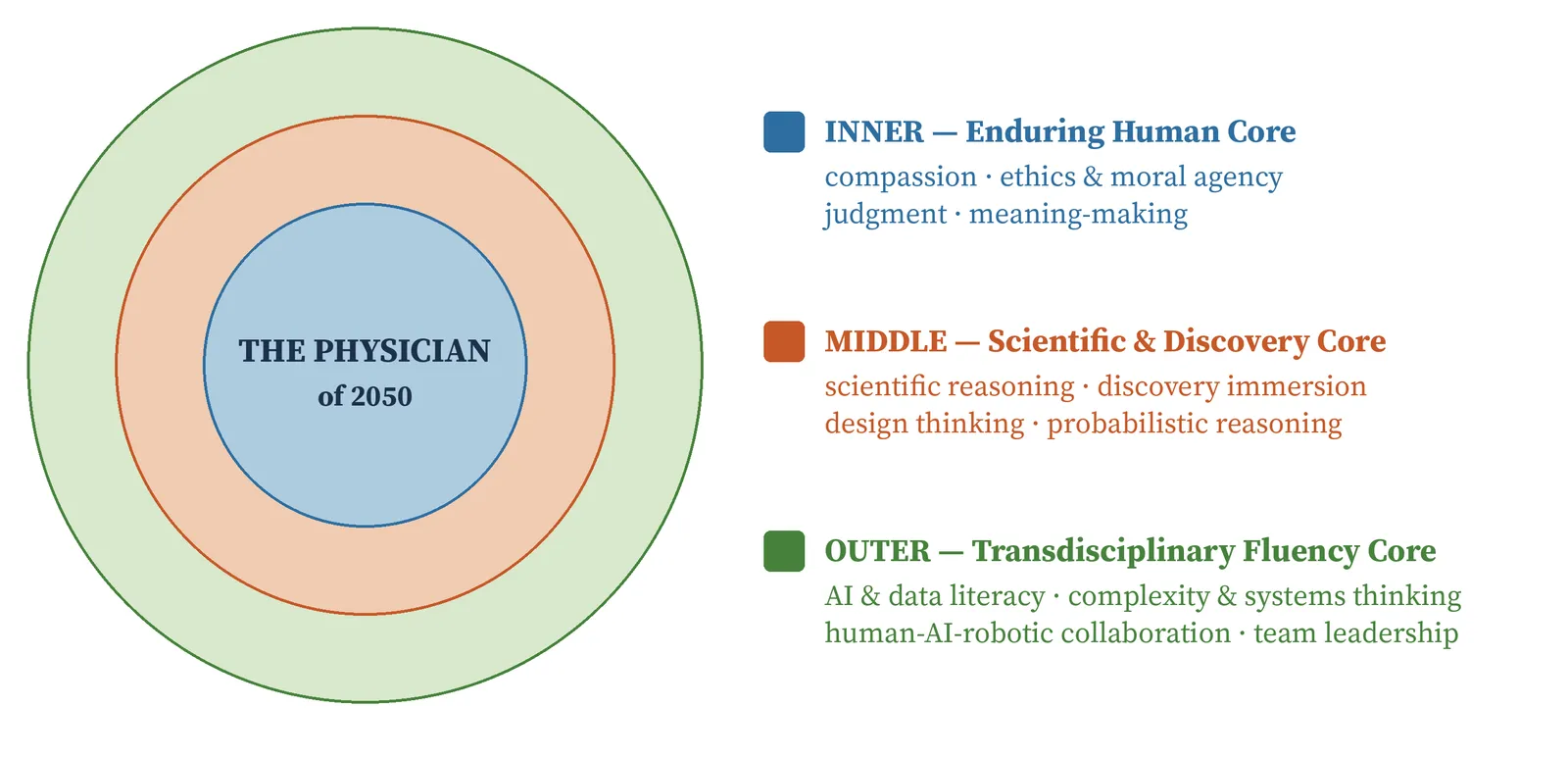
The exhibit pictures the future curriculum as three concentric layers around the physician of 2050. The inner layer is the enduring human core of compassion, ethics and moral agency, judgment, and meaning-making, drawn innermost because it is what the outer layers exist to serve and because it is most easily displaced by the pressure of the others.
The middle layer is the scientific and discovery core of scientific reasoning, discovery immersion, design thinking, and probabilistic reasoning, which keeps a profession coherent as its underlying science accelerates beyond any individual's grasp. The outer layer is the transdisciplinary fluency core of AI and data literacy, complexity and systems thinking, human-AI-robotic collaboration, and team leadership, which faces the world and changes fastest.
The outer layers equip the physician to work within a technological society; the inner core is what makes that physician irreplaceable within it. A curriculum that builds the outer without the inner produces a competent operator of systems; one that builds the inner without the outer produces a humane practitioner unable to evaluate the tools that increasingly deliver the care.
The cores are not simply the four identities restated in another vocabulary. The relation between them is what allows a single formative educational continuum to cultivate four identities. Each identity draws on all three in a characteristic proportion. The transcendent physician is weighted toward the enduring human core and is unintelligible without it; the technoscientific physician toward the scientific and discovery core, reaching outward for the instruments that make discovery possible.
The consilient physician lives principally in the transdisciplinary fluency core, since bridging domains is what that layer is for; and the global physician requires all three at close to equal weight, because stewardship at population scale demands the science, the systems fluency, and the moral grounding at once. Because every identity draws on every core, no core belongs to a subgroup of trainees, which is the argument for a common floor; because the proportions differ, the structure above that floor must flex.
A Reimagined Architecture: Foundational Elements
The three-competency core model guides what a medical school dean protects when resources contract. The enduring human core is drawn innermost because it is the most easily displaced, not because it comes first in time: the least examinable; the least fundable; the slowest to demonstrate its value; and the first thing a productivity metric removes.
The outer layers arrive with their own constituencies, since nobody has to argue for keeping physiology or for buying an ultrasound simulator. The layout of the schematic is therefore a claim about defense priority rather than about sequence: protect the center first, because everything else in the diagram has somebody else advocating for it. Chapter IX applies here with full force, since the center is also the layer the clinical environment is least likely to reinforce on its own.
The cores describe what a formation must build, though not yet what an institution would do differently, and Exhibit 11.2 makes that translation.
The exhibit is read from the center outward, with the four physician identities at the nucleus. Surrounding them are twelve foundational elements, the substantive commitments a reimagined educational architecture must contain. Beneath both is a band of enablers, the forefront mechanics of the educational process, encompassing curricular layout, didactic modality, assessment, and progression. The elements state what formation must include; the enablers, how it is delivered, examined, and advanced through.

The twelve elements fall into three families, each answering to one of the cores: formation and identity to the enduring human core; discovery and creativity to the scientific and discovery core; and breadth and collaboration to the transdisciplinary fluency core. The families complement one another in a specific way, formation supplying the why, discovery the how, and breadth the with whom.
Identity without method produces earnest ineffectiveness; method without identity produces technically able physicians with no account of what their ability is for; and both without collaboration produce practitioners unable to function in the distributed system Chapter VIII describes. The twelve are taken below in the order of the exhibit, several illustrated by models already operating somewhere in the world, since the novelty lies in assembling the pieces into one unified educational architecture instead of adopting them singly.
Training to identities and career pathways.Formation and identity. Following Chapters I and VI, a curriculum organized around specialty entry sorts a physician; it does not form one. This element names the four identities as explicit objects of development, tracks a trainee's evolving proportions among them, and builds career architecture that treats movement across practice, discovery, systems leadership, and public health as normal.
Diversification of entry routes and program length.Formation and identity. If identity is plural, the doorway should be too. This covers graduate entry, accelerated and dual-degree pathways, part-time study, and admissions selecting for the qualities the profession claims to value. The Gutwirth School of Medicine at the Weizmann Institute of Sciences enrolls every student in a combined MD-PhD pathway, with doctoral work available in physics, mathematics, or computer science; graduate entry is the norm in Australia; and multiple mini-interviews are established instruments for assessing communication, empathy, and integrity at admission. If character is the differentiated asset, who is admitted is in some ways a more powerful lever than what is subsequently taught.
Formalizing transdisciplinary education in biosciences and technosciences.Discovery and creativity. Chapter VIII argued that consilience must be engineered; Chapters II and IV supply the content it must reach. Formalizing means timetabled, examined, credentialed engagement, not an interest group and a lecture series. The standard is the one Chapter VII set: fluency enough to recognize when a clinical problem resembles one already solved elsewhere, short of expertise in these domains.
China's national strategy advocates medicine plus engineering, science, and X; Carle Illinois built engineering into the required curriculum; and the Harvard-MIT program has for half a century made engineers fluent in medicine without asking them to stop being engineers. The endpoint is a curriculum permanently built around integrated transdisciplinary learning rather than a transdisciplinary phase inserted into an otherwise conventional program, with the material recurring at every stage of formation instead of being discharged in one.
Data and complexity sciences as baseline proficiencies.Discovery and creativity. Chapter IV recommended that the technosciences transition from eclectic add-ons to core competencies embedded in every specialty's base training. Applied to formation, this covers data-aware medicine and layered validation, probabilistic and causal reasoning, the selective-inference discipline that N-of-1 care makes unavoidable, and complexity literacy. A proficiency offered as an elective is one the profession has decided some members may practice without.
Requiring discovery immersion.Discovery and creativity. Chapter VII held that relegating discovery to a subset of physician-scientists must be abandoned. Every trainee should experience the making of knowledge and not only its consumption, with breadth that includes implementation science, health services research, bioethics, and the humanities alongside laboratory and clinical work. Two failure modes attend it, the required project nobody supervises and the unfunded mandate that expects output from trainees with no protected time. University of Maryland requires every student to train in biomedical research methods, on the argument that a physician who has never designed a study cannot properly read one.
Human qualities established as core competencies.Formation and identity. Chapter IX held that these qualities are constitutive requirements of competent practice rather than traits some clinicians happen to possess, and that medical virtue is formed by habituation, which is a property of training environments. Establishing them as competencies means they are taught, observed, assessed, and resourced on the same footing as biochemistry, and that the psychosocial sciences enter as content, not as sentimental decoration. The methods are under-used rather than unavailable, among them close observation, structured reflective writing, and narrative medicine.
Modes of medicine as a coequal discipline.Breadth and collaboration. Chapter III described eleven modes operating at once and observed that none will dominate, so that a physician trained for one is trained for a minority of the future. This element makes the study of care delivery coequal with the basic and clinical sciences rather than a set of observations absorbed on the wards. Its most developed instantiation is health systems science; the framing here is wider, since it includes the learning health system and the physician's part in governing what it is permitted to learn.
Advancing interprofessional and integrative health education.Breadth and collaboration. Chapter VIII set out the maturity ladder for interprofessional education and argued for elevating it from supplementary enhancement to core curricular component. Two extensions belong with it. Laterally, the team includes the emerging complementary professions alongside the mainstream allied disciplines, which follows from Chapter V. Forward, it includes professions not yet formally constituted, among them AI mediation and digital health stewardship. The chapter's harder proposal also stands: trans-professional education, placing physicians in working interdependence with engineers, designers, lawyers, economists, and humanists.
Personalizing the co-curriculum and extra-curriculum.Formation and identity. If the identities are proportions rather than tracks, the space in which a trainee sets those proportions is largely the co-curriculum: projects, electives, concentrations, scholarly work, and experience accumulated beyond the academic medical center. Personalizing it means treating that space as one that is purposefully designed, not residual; resourced, not assumed; and advised, not left to whoever has the confidence to ask.
Cultivating creativity and curiosity through human design and design-thinking projects.Discovery and creativity. Chapter VII observed that design breakthroughs in medicine demand no sophisticated technology, only curiosity and a willingness to challenge the assumed, and that curiosity is an environmental variable managed across a career. This element supplies the counter-pressure: projects in which trainees observe how care actually happens, identify where it fails the person, and reconceive the arrangement. Stanford University School of Medicine's Biodesign fellowship exemplifies this model, running clinicians in mixed teams with engineers and designers from unmet need through prototype to regulatory strategy. Another example is the Medicine + Design co-curricular offering at Thomas Jefferson University’s Sidney Kimmel Medical College, wherein medical students in their second-year team up with industrial design, textile design and architecture students for 9-month expert-guided projects that apply human design thinking to the identification and solution of real-world clinical challenges.
Mandating global experiences.Breadth and collaboration. Chapter X recommended that global health be ingrained in formation in a structured, integral way, and noted that much of it need not require boarding a plane. Case-based sessions across health systems, joint research and design projects, shared journal clubs, and collaborative quality-improvement work all operate at distance. The glocal framing is its practical center, since the determinants producing ill health in a refugee settlement operate, in different proportion, in the catchment of every teaching hospital.
Guiding entrepreneurship.Breadth and collaboration. Chapter VII identified entrepreneurship as one of two vehicles by which a physician's discovery reaches practice, and observed that institutions making the path administratively impossible mainly export their best ideas to people less scrupulous about disclosure. The proposal is not that medical schools produce founders but that they guide the trainees who will attempt it, through conflict-of-interest management, intellectual property, regulatory pathway, reimbursement, and the capital structures that determine which translational problems are solved. Extracurricular experiences at biotech startups and financial institutions operating in the healthcare space provide one path to cultivating entrepreneurial spirit and know-how in medical trainees.
Enablers: The Mechanics of Formation
The foundational elements will not install themselves. The band beneath them in Exhibit 11.2 names four kinds of machinery—curricula, didactics, assessment, and progression—distributed across nine enablers.
Flexible curricular design. The container must change before its contents can: by example, vertical and spiral integration in place of a front-loaded science phase, the learning environment treated as a designed object, shared module libraries, and options for longitudinal integrated clerkships in place of time-limited blocks (allowing for longitudinal patient-following that gives a trainee one relationship outlasting every rotation).
Collaborative learning environments. Medical education still assesses individuals in a profession that practices in teams, and in a distributed system of the kind Chapter VIII describes, that mismatch is no longer tolerable. In practice this means shared problems with interdependent parts, assessment capturing contribution to a group outcome, and deliberate composition of teams across professions and levels of training. The established formats are team-based and case-based collaborative learning, near-peer teaching, and concept mapping built by students instead of supplied to them. Fostering classroom and project-based interaction between medical students and those outside of the biomedical sphere becomes part of cultivating the consilient physician.
Faculty upskilling. Every element above assumes faculty who can teach it, and most currently cannot. This covers the domains the elements introduce, among them data and complexity science, AI collaboration, and design methods, and the pedagogic skills the enablers require, among them debriefing, coaching, and the assessment of group performance. Faculty development is curricular infrastructure rather than a support function attached to reform.
Higher-order simulation and immersive reality. Simulation has too often been treated as simply a tool for procedural rehearsal. Its frontier lies in judgment under ambiguity, team behavior under stress, ethical decision-making, and the human dimensions of the encounter. Immersive reality extends its reach into shared environments across institutions, generative virtual patients into conversation at scale, and in-situ simulation into the working unit. The following section takes this up at length.
Enhanced early clinical immersion. Early exposure exists in most curricula but is too often observational, producing exposure without formation because nothing is at stake and nothing is continuous. Made impactful, it requires responsibility calibrated to competence, continuity across a small panel of patients so that the consequences of decisions are met and not only their moments, and coupling to simulation, so that what is encountered in clinic is rehearsed and then encountered again. That loop converts experience into judgment, and its absence explains why years of exposure can produce so little of it.
Real world experiences. Distinct from clinical immersion, this places trainees in authentic roles that improve care while they learn, and in the communities where the determinants operate. Penn State's patient navigator program is a clear instance, pairing every first-year student with a navigator mentor. Student-run clinics, distributed placements of the kind the Northern Ontario School of Medicine runs, and structural competency training also sit here. This is where the socially responsible physician of Chapter X is formed.
Individualized student progression. This is the assessment and advancement machinery, where personalization meets the institution's need to certify. Competency-based, time-variable progression built on entrustable professional activities is the mature international model, realized most fully in Canada's Competence by Design and in the Dutch national rollout, and programmatic assessment, developed at Maastricht, replaces isolated high-stakes examinations with a designed system of low-stakes data points aggregated for decisions. These allow trainees to move at different rates through different proportions without the institution losing the ability to say what a graduate can do.
Personalized career-spanning storyboards. Tracking a formation of this kind requires more than logged procedures and completed modules. The proposal, developed later in this chapter, is a longitudinal account of a trainee's experiences, simulations, and didactics, following biomedical competencies, other proficiencies, cross-cutting knowledge domains, and human qualities development together.
Individualized longitudinal mentoring and advising. This is perhaps the single highest-yield structural change available. No common curriculum can produce the four identities, because the proportions are meant to differ for every physician. What allows a trainee to find their own combination is sustained relationship with someone who knows them. Mentoring is where the personalized co-curriculum becomes possible, where identity formation is observed, and where the human qualities of Chapter IX pass from one physician to the next by example. It is also the first thing productivity pressure removes.
What makes all of this difficult is time slot displacement rather than disagreement. A curriculum is a fixed volume, and every addition requires a subtraction that some constituency will contest. Discovery immersion, design projects, global experiences, simulation, and mentoring all consume the scarcest resources in the system, protected time and faculty attention, and all compete against content that is examined and therefore defended. Content not built into the structure, examined, and resourced will be displaced by content that is, however strongly its importance is affirmed in a mission statement.
The Next Generation of Thinking
Twelve foundational elements cannot be inserted into four years that are already full, and every attempt to do so produces the tokenism named in Chapter VII: the requirement met, the hours logged, the formation absent. If the elements are necessary and the volume is fixed, then either the elements are abandoned or the container must be restructured. Modular, distributed formation makes the twelve achievable because it stops treating the years before licensure as the only period in which a physician can be formed.
Everything above works within the inherited structure of physician formation, and that structure may change more radically than this report elsewhere assumes. The century-old sequence of medical school, residency and fellowship, and episodic continuing education presumes that knowledge is scarce and that skills are acquired by prolonged apprenticeship, both best front-loaded. Each premise is weakening. Physicians might instead be formed through shorter, modular periods of education, a substantial part delivered on the job, with structured simulated experience preceding each move into apprenticeship.
Two further frontiers are moving now. The first is binding mechanism, which decides what remains optional: Germany's NKLM, Japan's revised Model Core Curriculum, the United Kingdom's licensing assessment, and CanMEDS each made a set of commitments that are binding instead of aspirational, and Chapter XII takes up what that would require of the bodies that collectively control the profession. The second is formation for the machine partnership, taken up in the section that follows.
These changes depend on the courage and leadership of a medical education establishment that has tended to be slow in adapting to the world around it. The technologies will arrive regardless, and whether physician formation evolves to meet them is a question of institutional will rather than of technology. The limiting factor is often the rate at which systems and the workforce absorb capability, not the capability itself. Whether medical education is deliberately hardwired is the central leadership choice for the mid-21st century.
Ideas on this section
No ideas linked here yet. Propose an extension, a counterpoint, or a way to test a claim.
Discussion
Annotate this section — questions, counterpoints, references.
No comments yet. Start the thread.