Intelligences Meet: The Human Advantage
Even if AI superintelligence is achieved, a compelling human niche will persist.
Even if AI superintelligence is achieved, a compelling human niche will persist.
Exhibit 6.1 maps capabilities against two axes: machine suitability on the horizontal, human essentiality on the vertical. Three territories emerge.
The upper-left territory is irreducibly human, and it holds three kinds of thing: values and meaning-making, standing and accountability, and judgment exercised where no reference class exists.
The lower-right territory is the mirror image: delegate to machine. It holds the work that rewards scale, speed, and consistency rather than standing or stakes, from image and signal interpretation through literature synthesis, risk stratification, documentation, and the monitoring of continuous streams. Delegation here is the point rather than a concession, since work discharged by a machine is work returned to the physician for the territory above.
Between them lies the broad diagonal band of augment and oversee, the shared ground where both intelligences contribute and neither is sufficient. Discovery and foresight sit here, skewing machine. Care, ethics, and guidance sit here, with clinical judgment and ethical reasoning split. Expression and influence sit here, skewing human.
Exhibit 6.2 sets the same argument out as a ledger.
Human advantages cluster around being a subject with stakes and standing. Machine advantages cluster around the mechanics of cognition, and they are the advantages that bandwidth-limited cognition most conspicuously lacks. Those are different kinds of thing, and no amount of improvement in the second produces the first.
The left column can be called meaning-based intelligence: understanding grounded in meaning, context, values, and lived experience, as against intelligence grounded in pattern recognition and statistical association. The distinction bears hardest where machine output is most fluent, because fluency is readily mistaken for comprehension, and a system can produce the sentence a situation calls for without holding the situation. The physician's work begins after the output arrives, in determining what it means for this person, whether it fits their circumstances, and whether it serves what they are actually trying to do with a life.
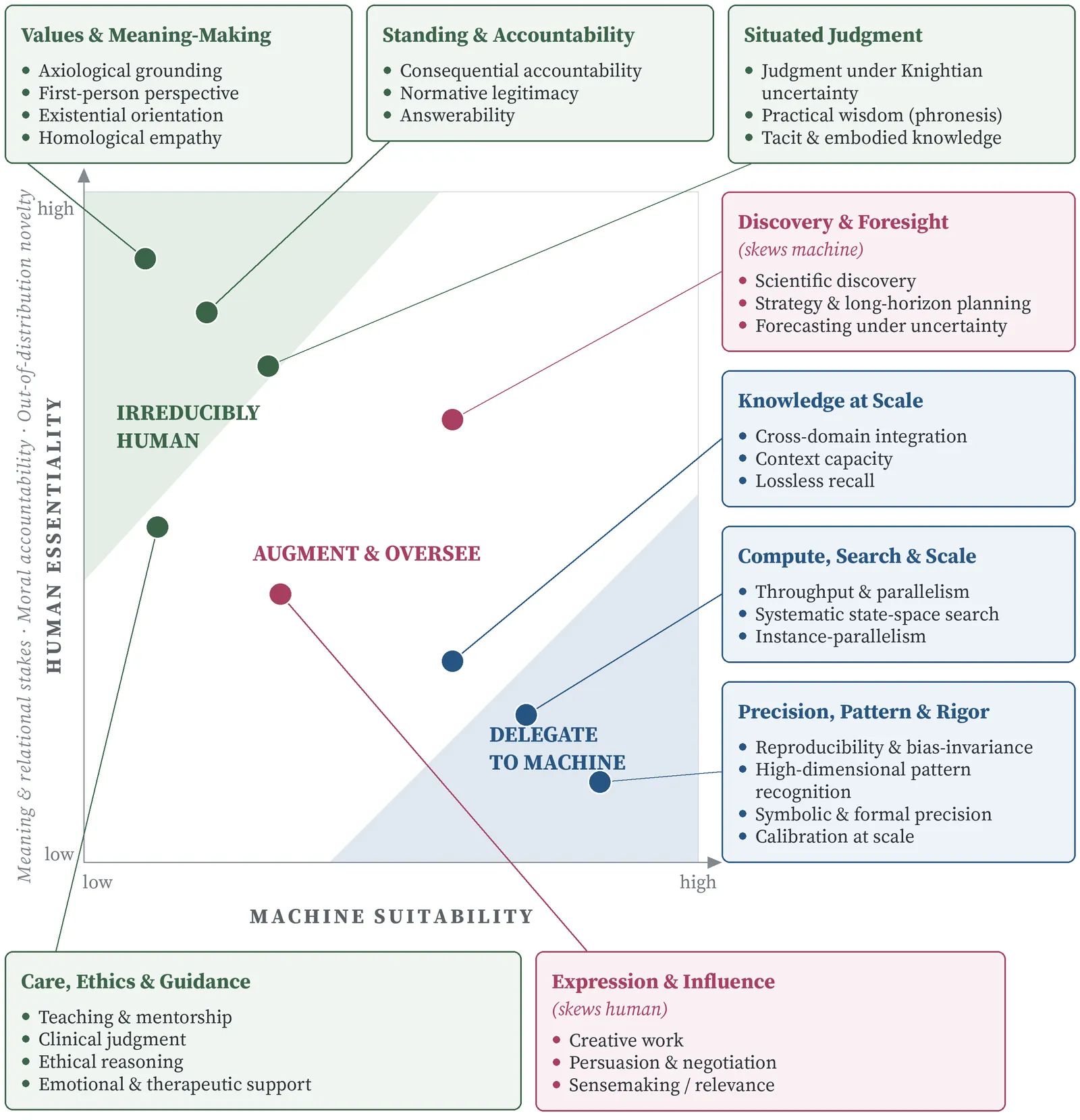
One caution governs how the map should be read. The distinction between what machines handle well and what they do not is often taken to fall between whole domains, so that a specialty can be judged safe or exposed as a unit. It falls instead between kinds of question, and the kinds coexist inside every domain.
The analogy is the treatment of consciousness, where tractable questions and questions about subjective experience sit side by side within one subject. Biomedicine is arranged the same way, and a specialty may be substantially automatable in its interpretive work and barely touched in its deliberative work. Treating Exhibit 6.1 as a ranking of specialties, when it ranks questions, is therefore the characteristic error. It will produce confident predictions about which fields are safe that the following decade will not support.
Four further readings run across the two columns, and each sharpens the claim in a different direction.
- Origination against transformation. Every machine advantage operates on something already given: a corpus, a state space, a distribution, a specification. Every human advantage either originates that given or stands outside it. Machines are downstream of a specification by construction, and the act of specifying is where the human sits.
- The indexical against the statistical. Human advantages attach to this: this patient, this moment, this situation whose kind is not yet known. Machine advantages attach to classes: structure in high-dimensional spaces, calibrated estimates over distributions, near-exhaustive search of a defined space. One intelligence is indexical and the other statistical, and clinical medicine needs both because a patient is simultaneously an instance and a person.
- The singular against the scalable. Every machine advantage multiplies: throughput, parallelism, and above all instance-parallelism, the best reasoner cloned a million times over. Not one human advantage scales. Accountability cannot be copied, a first-person position cannot be instanced, and standing cannot be replicated without being destroyed. That asymmetry is usually taken for a human weakness. It is better understood as the reason the human advantages are the ones that confer authority.
- Vulnerability against invulnerability. The machine column is a catalog of immunities: no fatigue, no mood, no anchoring, no decay. The human column is a catalog of exposures: bearing the cost of being wrong, reasoning in the light of finitude, understanding suffering as the same kind of creature. The traits that make a machine reliable are the ones that disqualify it from bearing consequence.
A fifth reading subsumes the others. Machine advantages make a decision better. Human advantages make it a decision at all. Someone must be answerable, someone must have standing with those who will live under the outcome, and someone must be able to say what kind of situation this is before any of the machinery can be pointed at it. The machine column is instrumental. The human column is constitutive.
Three head-to-head pairings make this concrete, and in each the machine entry is the stronger of the two on its own terms.
Lossless recall against tacit and embodied knowledge. Machine memory is perfect and, above all, articulate: everything it holds was written down, and everything written down is retrievable exactly. Tacit knowledge is the complement, the residue Polanyi named when he observed that we know more than we can tell. The machine has everything the profession recorded. The physician has the part it never managed to record, which is much of what separates a good clinician from a well-read one.
Calibration at scale against judgment under Knightian uncertainty. Calibration, the conversion of weak signals into well-tuned estimates, is an undervalued machine strength, and it presupposes a reference class and a space of outcomes. Knightian uncertainty is the regime in which no reference class exists, and the question shifts from what the odds are to what kind of situation this is. A perfectly calibrated system is calibrated over the space it was handed, and nothing inside it can detect that the space is the wrong one. The physician's contribution at that moment is the recognition that estimation is not yet the right activity.
Instance-parallelism against answerability. The strongest single entry in the machine column is the best reasoner cloned a million times over, and that same entry destroys accountability most directly. A decision issued by an entity that can be instantiated at will has no one who bears its cost, no one whose standing is at risk, and no one who can be called to answer for it afterwards. Accountability is singular by construction, and this is not a shortfall that better engineering removes, because the copying is the capability.
The middle column of the exhibit is the one most likely to be misread, and most clinical work actually happens there. Productive interplay is not a tie: discovery and forecasting skew toward the machine, sensemaking and therapeutic support toward the human, teaching sits balanced, and clinical judgment splits internally, with diagnosis skewing machine while the goals-of-care conversation stays human.
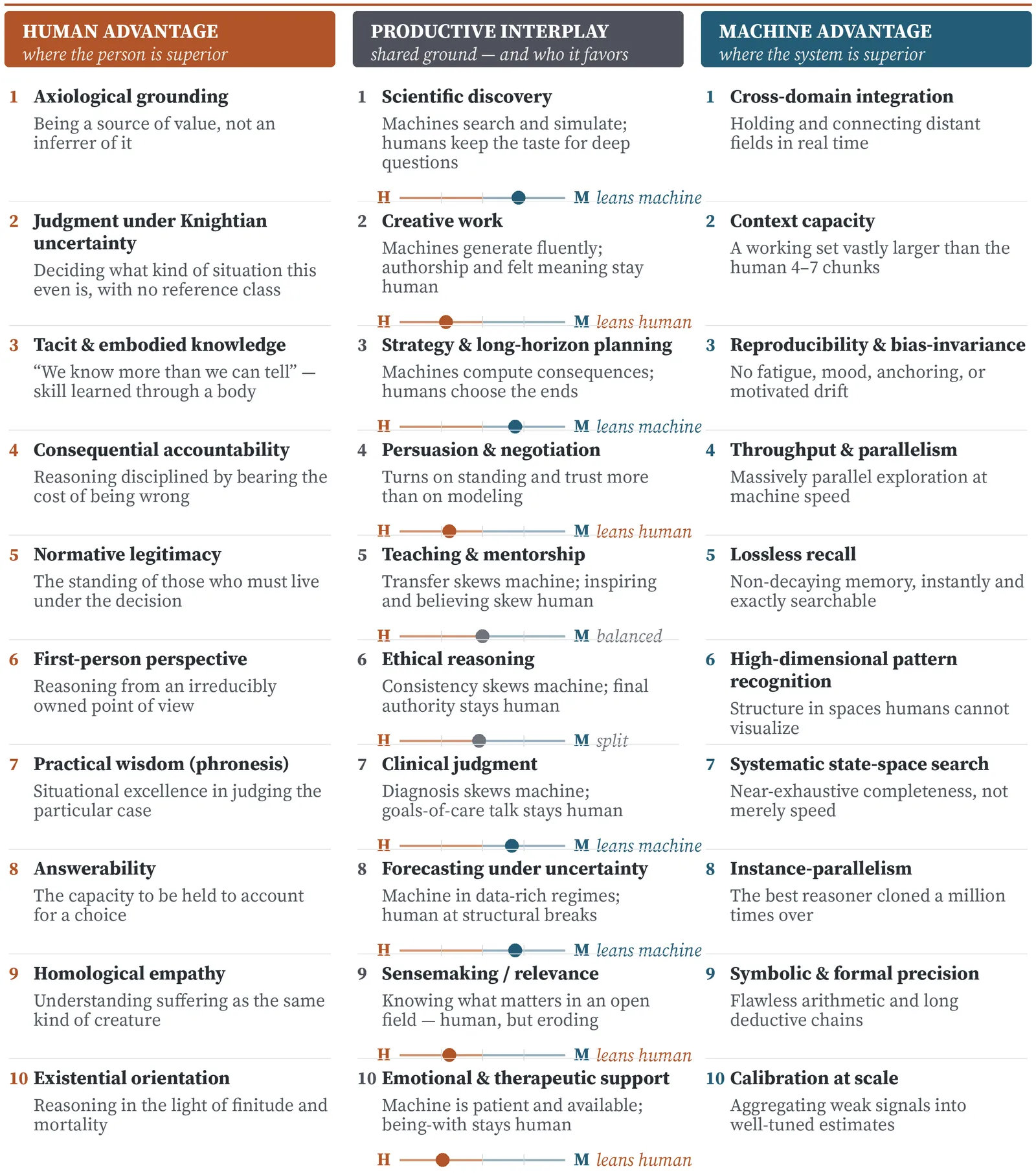
That split is the most consequential line in the exhibit, because it runs through the middle of a single activity the profession has always treated as one thing. Much of the disorientation of the coming decade will come from discovering that clinical judgment was never a unitary capability.
This identifies which human claims are durable and which are not. Any claim resting on knowing more, remembering better, or seeing patterns faster is already lost and should be surrendered without protest. Claims resting on being answerable, on having a life at stake, on occupying a first-person position, and on being the kind of creature the patient is, are not capability claims at all, and improvement in machine capability does not touch them.
Surrendering those claims carries an institutional price the profession has not counted. Admission to medical school still selects heavily for recall and for speed at answering questions. Licensing examinations still test knowledge a model now holds more completely than any graduate will. Board certification still asks what a physician remembers, not whether a physician can verify. Nothing in the apparatus assesses judgment under uncertainty that will not resolve, or the willingness to be answerable for a decision made without a rule.
The profession is therefore selecting and credentialing for the capabilities it is conceding, and doing so at every gate. Until the gates change, formation will keep producing physicians optimized for a competition already lost, which is why the assessment reforms of Chapter XI are the mechanism that makes the surrender survivable.
One consequence of that surrender changes the structure of practice rather than merely its content. If patients arrive already informed, already analyzed, and equipped with decision support of their own, the physician ceases to be the default entry point to care and becomes a selectively engaged advisor within an ecosystem the patient is largely directing. Routine self-care and self-medication proceed without consultation, and the physician is consumed at junctions of genuine need and genuine uncertainty.
This is a differently distributed role rather than a diminished one, and it concentrates physician time precisely where the human advantages above are decisive. The risk it carries is also specific. A profession engaged only at junctions loses the continuity from which knowledge of a person accumulates, and that continuity is the substrate of nearly everything Chapter IX will claim.
Continuity can be reconstructed, though not by hoping the encounters return. If the physician is engaged at junctions, what accumulates between junctions has to be carried by something other than the relationship: by a longitudinal record built to hold a trajectory; by the twin of Chapter V; and by whatever the patient's own monitoring has learned in the interval. The physician's task at each junction then includes an act unrecognized in current practice: re-entering a life already in progress quickly enough to be useful, from a record designed to make that possible. Continuity of that kind is re-established rather than accumulated. It is worse than the old kind in some respects and better in others, since a record does not forget and does not retire.
A caution belongs beside that optimism. Recent economic modeling of delegation shows that skill improves through use and decays under non-use. Rational reliance on a capable system can therefore drive a clinician toward a stable low-skill equilibrium, improving short-run performance while inducing persistent long-run loss.32 The same work finds that those strong at verifying AI output are amplified by it, while those weak at verification over-delegate and degrade. Verification skill, not delegation, is the competence to cultivate.
Notes
- 32Lingxiao Huang and Nisheeth Vishnoi, "The Geometry of Learning Under AI Delegation," Cowles Foundation Discussion Paper 2499 (March 2026); Lingxiao Huang, Wenyang Xiao, and Nisheeth Vishnoi, "Delegation and Verification Under AI," Cowles Foundation Discussion Paper 2500 (March 2026).
Ideas on this section
No ideas linked here yet. Propose an extension, a counterpoint, or a way to test a claim.
Discussion
Annotate this section — questions, counterpoints, references.
No comments yet. Start the thread.