Complexity, Data, and the Limits of Prediction
The nexus of complexity science and biomedicine is a rich conceptual space with almost endless possibility, and working seriously inside it, the physician adopts newly configured roles, as a decipherer, navigator, and engineer of complex adaptive systems.
The nexus of complexity science and biomedicine is a rich conceptual space with almost endless possibility, and working seriously inside it, the physician adopts newly configured roles, as a decipherer, navigator, and engineer of complex adaptive systems.
Chapter IV introduced complexity science in general terms: complex adaptive systems, the quarter-power scaling laws, and the caveat that the field's record of prospectively validated clinical prediction is uneven. This section translates this to the physician. The value of complexity science is mainly epistemic, since it identifies in advance the situations in which linear, single-cause, average-based reasoning is about to fail at the bedside, in a way no quantity of additional data can change. This framework explains why the reasoning style medicine teaches often breaks down where medicine is hardest.
The three roles cited above are a sequence rather than a list. Deciphering is reading a system well enough to say what kind of system it is, where its couplings run, and which regime it currently occupies. Navigating is acting inside that system while the reading remains incomplete, which it permanently will, so that timing, reversibility, and the length of the feedback loop matter more than the precision of any single estimate. Engineering is shaping the system. A physician already does all three, unnamed and untaught. Naming them is what makes them teachable.
The complexity science·physician nexus applies to a range of settings and scales, and six can be usefully distinguished:
- Fundamental biological mechanism. Mechanism is taught as a diagram: a pathway, a receptor, a cascade with an arrow at the end. Complexity science replaces the diagram with a dynamical object. Gene-regulatory networks resolve into attractor landscapes, so that a cell type is a stable basin and differentiation is movement between basins, which is the conceptual basis of reprogramming. Proteins fold across energy landscapes and populations move across fitness landscapes, and the same mathematics describes both. West, Brown, and Enquist derived metabolic rate, heart rate, and lifespan from the fractal geometry of the networks that distribute resources through an organism, so that structure at one scale fixes rate at another. What the physician gains here is a different account of what a mechanism is, not a longer list of mechanisms.
- Pathogenesis. Disease becomes a perturbation of a network rather than a lesion in a part. Barabási's diseasome showed that conditions sharing modules in the human interactome tend to co-occur, which reframes comorbidity as topology: two diagnoses appearing together are often one perturbation seen from two vantage points, and multimorbidity becomes a single object with its own structure. Tumors and pathogen populations evolve under the selection pressure that treatment itself applies, which in a sense makes resistance a designed outcome. Syndemics carry the same concept into the social layer, where conditions cluster because the circumstances producing them cluster. In each case, pathogenesis stops being a category and instead becomes a trajectory, and the clinical question moves from what does this patient have to where in the space is this patient, and moving which way.
- Clinical diagnostics and therapeutics. Complexity thinking can sometimes outright overturn something a physician was trained to believe. Goldberger's fractal physiology showed that healthy systems generate irregular, self-similar fluctuation and that disease often presents as the loss of it, since heart failure, diabetic neuropathy, and fetal distress all show more regular heart-rate dynamics. The orderly trace is the finding, variability itself becomes a vital sign, and threshold-based monitoring cannot see it, which means nearly every monitor now in use cannot see it. Critical slowing down, meaning rising autocorrelation and variance as a system nears a tipping point, announces deterioration dynamically before it announces itself clinically. On the therapeutic side, Gatenby's adaptive therapy preserves a drug-sensitive tumor population precisely because that population suppresses resistant clones, which contradicts the maximum-tolerated-dose logic on which oncology was built. Dose stops being a number and becomes a control strategy.
- Modes of medicine. Chapter III described a constellation of care paradigms rather than a succession of them, and that constellation is itself an adaptive system. Modes do not replace one another. They interlace, compete for the same patients and the same staff, and shift load onto each other in ways none of them plans. A learning health system is a feedback loop, which means it can oscillate, drift, or lock in, and Arthur's work on increasing returns explains why the arrangements now forming around clinical AI, its data standards, its liability conventions, and its division of labor, will harden long before the technology matures. Model drift is the same phenomenon on a shorter clock. The physician's task at this scale is governance of what the system learns, which is a design act as much as a clinical one.
- Healthcare system architectures and operations. Hospitals run near criticality, which is why they behave linearly until they do not: occupancy climbs smoothly and waiting times explode, and the threshold is a property of the system rather than of any decision taken on the day. Error is emergent, arising from the coupling of individually competent parts, which is the premise of resilience engineering and of Safety-II, where the object of study is why work usually succeeds, not why it occasionally fails. Supply chains are fragile in the technical sense, absorbing perturbation until one tightly coupled node fails. Plsek and Greenhalgh made the argument directly, that care delivery is itself a complex adaptive system and is managed by cultivating adaptive capacity instead of by imposing control. Much of what health systems experience as operational failure is the cost of ignoring that premise.
- Interfaces of care with individual patients, communities, and global entities. At the widest scale, the physician's instrument changes. The clinical dyad at the individual patient level is a coupled system in which expectation, trust, and adherence feed back on physiology. At the level of communities, network epidemiology and infodemic contagion govern how disease and belief about disease travel through the same social topology. At the global level, spillover under One Health, antimicrobial resistance, and planetary health are coupled dynamics that no jurisdiction contains. What unites the three is that instruction is not the operative lever. Populations and institutions are not instructed. They are given incentives, constraints, defaults, and information, and then they adapt.
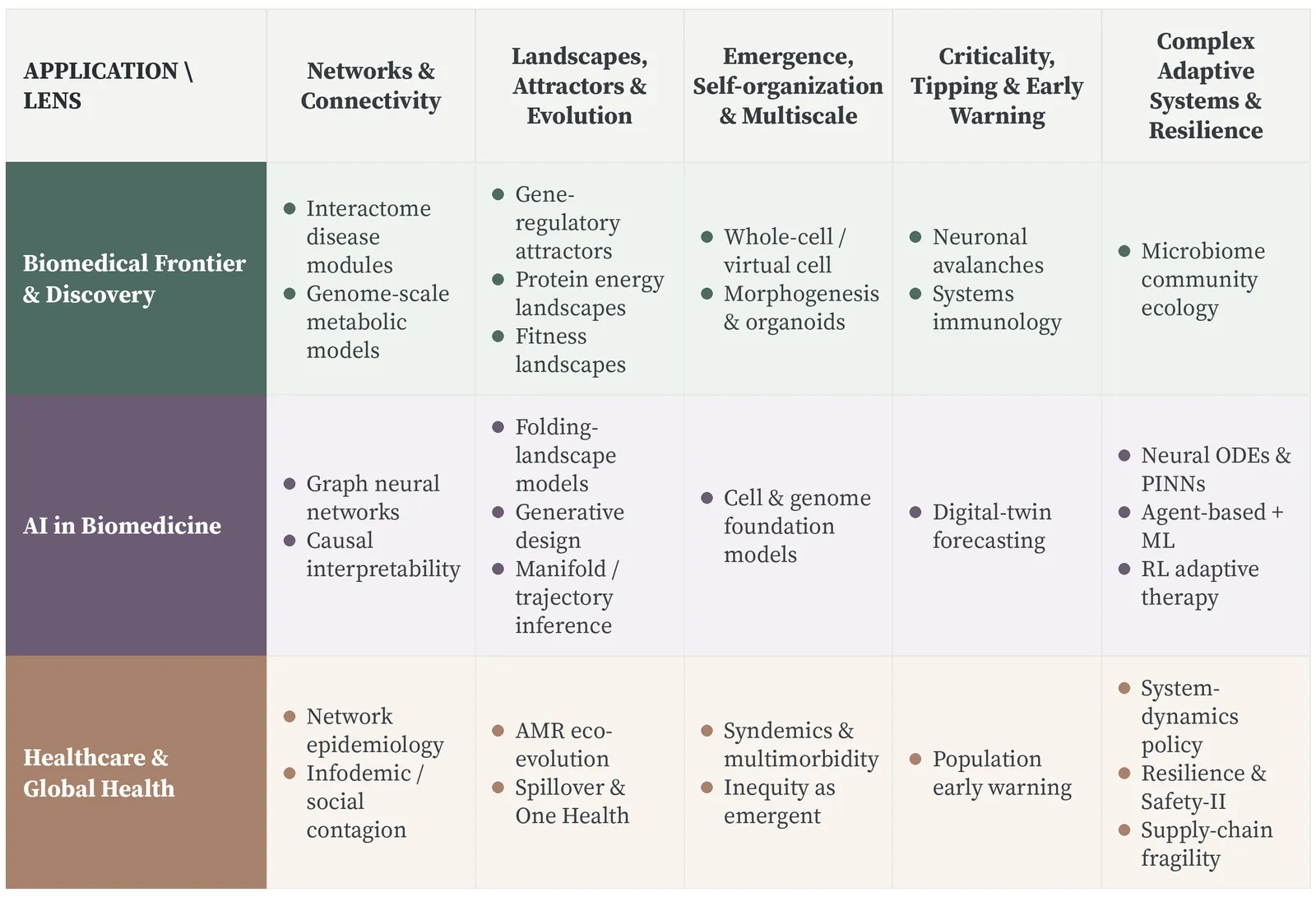
Reductionist biomedicine asks what the parts are. Complexity science asks how they are coupled, and coupling turns out to be what determines behavior. Exhibit 9.1 maps exemplary complexity·biomedicine application domains across five complexity science lenses. The three application domains: the biomedical frontier, where discovery of the complex occurs; biomedical AI, as an instrument to decipher complex data; and healthcare, predictions meet a messy, adaptive world. Each is rich with subjects that are reframed and enriched when viewed through one or more of the five complementary complexity science lenses.
Emergent Bioengineering
New fields emerge as complexity science takes hold. One example is in the engineering space.
David Krakauer, president of the Santa Fe Institute, made the case for emergent engineering in the closing chapter of Worlds Hidden in Plain Sight, the volume he edited to mark the Institute's first thirty-five years.56 Classical engineering assumes components whose behavior is specified; failure rates that are low and characterized; information that is adequate; dynamics that stay linear across the operating range; and parts that do not change while being used. Krakauer sets out five properties of complex systems, and adaptive systems violate every one of those assumptions. We hold few general design principles for adaptive components, whether cells, organisms, or nations, in isolation or in the aggregate, where new and unforeseen properties emerge. Components fail at high rates in every task and reach their objectives by statistical averaging and approximation across multiple scales and levels. Uncertainty and missing information are the normal condition at component and aggregate level alike, and components carry large and often poorly understood repertoires of behavior. Most evolved complex systems operate in nonlinear and often near-critical regimes, close to thresholds and tipping points. And adaptability of components is the rule rather than the exception, since learning and adaptation are ongoing and irrepressible.
Against those five properties Krakauer sets five objectives for what he calls emergent engineering. Modify the reward or selective context in which semi-autonomous agents operate, and design toward incentives. Accept significant component error rates, and build mechanisms that average and aggregate those errors to acceptable levels in the collective output. Design with an eye to distributions of outcomes rather than to single optimal ones. Develop means of controlling nonlinear dynamics and of predicting and influencing critical transitions. And harness adaptation so that exploration continues, instead of coercing a system into a single state that has to be held there by endless and costly intervention.
This all translates to clinical medicine in an uncanny way. Drugs can behave differently in the patient than expected from the trial. Diagnostic tests can be individually unreliable and are often used in combination for that reason. The information available at the moment of decision is almost never adequate. Pathophysiology is nonlinear and frequently sitting near a threshold. And every part of the system, the tumor, the pathogen, the patient, the clinician, and the institution, is learning while being acted upon.
This translates to what might be termed emergent bioengineering. Designing toward selective context rather than toward a specified end state is what adaptive therapy does to certain pathogenic processes, what stewardship does to a hospital's care delivery profile, and what a well-built prevention program does to a population. Accepting component error and averaging it is the logic of the cross-check, and the team ensemble itself, and it is why the correct response to human fallibility is redundancy rather than exhortation. Designing toward distributions is what a trial reports. It is then lost in the treatment plan for a given patient, since the plan is usually written as though the mean were the patient. Controlling nonlinear dynamics and anticipating transitions is early-warning medicine, whether in one physiology or in a population. And harnessing adaptation instead of suppressing it is the difference between a therapy that steers and one that sterilizes, at the level of the tumor, the microbiome, and the health system alike.
Krakauer draws a futher conclusion that applies to medicine squarely. The maturation the complexity-informed approach requires, he argues, is a willingness to live with relatively high levels of uncertainty in complex domains, and therefore to give up on ideas like complete cures, the elimination of risk, the design of perfect stability, and the achievement of total security. These deterministic ideals are to be molded by an understanding of adaptive processes as ever-evolving, and seeking instead to move outcomes into a space of desirable, though never optimal, performance.
Cure is the vocabulary of oncology and infectious disease. The elimination of risk is the vocabulary of screening and of consent. Stability is the vocabulary of chronic disease management. Security is the vocabulary of public health. None of them should be surrendered as an aspiration. Yet, all four mislead as descriptions of what treatment does to an adaptive system. A narrower and more useful formulation is that medicine moves a patient into a space of desirable, though never optimal, performance, and then keeps the patient there while the patient and the world go on changing. A profession that said so would promise less and disappoint less, and it would be describing what it actually does.
The Limits of Prediction
In a complex adaptive system such as a patient, a disease, or a health system, behavior emerges from nonlinear interactions and cannot be read off the component parts. More data does not guarantee more foresight, and uncertainty and biological complexity can be reduced but never eliminated.
In facing the limits of prediction, the transcendent physician must attain a deeper understanding of the nature and genesis of those limits. Insights trace to the complexity tradition centered on the Santa Fe Institute. One relates to taxonomy. The Institute's Limits to Prediction workshop, convened by Joshua Grochow and David Krakauer, separated four reasons a system can resist prediction: the dynamics may be inherently unpredictable, as in chaotic systems; the cost of measuring to sufficient accuracy may be prohibitive; the computation may be intractable even given unlimited data; and the state space itself may be unknown, as in systems that adapt, evolve, or innovate.57
Each class can be mapped to a clinical situation and implies a different response. Inherent dynamical unpredictability, as in seizure onset or arrhythmia initiation, calls not for better forecasting but for shorter feedback loops and reversibility designed into the plan. Prohibitive measurement cost fails for economic rather than mathematical reasons, and the response is triage of measurement. Computational intractability leaves some questions unanswerable at any data volume, and is most often misread as a temporary engineering limitation. Unknown state space is the deepest class and defines the physician's territory: tumors evolve, pathogens emerge, and a patient's circumstances, values, and goals change, so no model can assign probability to an outcome its state space does not contain. This is the Knightian regime of Chapter VI, where the question shifts from what the odds are to what kind of situation this is.
A second insight goes deeper. Brian Beckage, Louis Gross, and Stuart Kauffman distinguish a system's intrinsic predictability, its theoretical ceiling, from its realized predictability, what is achieved with available models, and the two failures look identical from inside the clinic while calling for opposite responses. Their central claim is that biological systems are widely limited by computational irreducibility: future states cannot be derived except by computing all the intervening ones.58 Transposed to a patient, the argument is apt. A life's trajectory has to be lived to be known, and the patient generates novel states that no state space anticipated. This is not a defect in current models awaiting better ones. It is a property of the object being modelled.
Those two insights bound the problem. They leave a practical question unanswered: given a predictability ceiling, what is the best model to hold? Seth Lloyd, writing in the same volume, supplies the constructive half.56 His subject is what a controller must know in order to act on a complex system. He combines two quantities usually kept apart: the algorithmic information contained in the rules a model uses to describe a system's regularity, and the probabilistic information left in whatever that model still treats as random. Their sum is total information. As a model acquires rules, it captures more regularity and the apparent randomness falls; acquire too many and the description complexifies more than the disorder it removes. What the controller counts as order and what it counts as disorder is to that extent its own choice, and the trade between them is not zero-sum.
Reaching a minimum of total information means one has obtained a complete description of a system's predictable features and expressed it in the most compact available form. Lloyd's deeper claim is mathematical rather than intuitive: in a maximum-likelihood theory of inductive inference, the model that minimizes total information can be shown to be the maximum-likelihood model, which is to say the most concise model that makes the best possible predictions given the data. Concision and predictive power, which clinical culture treats as a trade, coincide at the optimum.
Three consequences follow for data-rich medicine, and each is counterintuitive. First, a model that keeps acquiring parameters past the minimum is not being thorough, it is moving away from the best prediction available to it. Second, in a world flooded with information, the capacity to ignore selectively grows more valuable. Any system seeking to control its environment, whether a consumer, a scientist, or a robot, must build models that decide what information to acquire and how to act on it. That is a description of the physician in front of a continuous data stream, and it makes deciding what not to measure a clinical skill, not merely a concession to cost. Third, the trade in total information identifies the sampling rates and resolutions at which a system is observable and controllable, and Lloyd's point about natural scales is that as sampling grows finer and more frequent, a scale can arrive at which a system that was uncontrollable suddenly becomes controllable. That is a strong, principled argument for continuous monitoring and for the biomedical digital twin of Chapter V.
The physician competence that follows is specific and teachable: the ability to tell which kind of unpredictability one is facing. Mistaking irreducible uncertainty for remediable ignorance produces over-testing and false precision. Mistaking remediable ignorance for irreducible uncertainty produces premature fatalism. This also disciplines the enthusiasm surrounding digital twins and continuous monitoring, which raise realized predictability, sometimes dramatically, but not the intrinsic ceiling. More data closes the realized gap and leaves the intrinsic gap exactly where it was, which is the precise, non-rhetorical sense in which complexity sets a permanent ceiling on prediction.
What that discrimination looks like can be shown on a single patient. An older man with heart failure, diabetes, and depression is losing weight. If the cause is a drug interaction nobody has tabulated, the unpredictability is remediable ignorance: the answer exists, it is not yet in hand, and more information is the right response. If the weight loss reflects three conditions and four drugs whose combined behavior no trial has studied, the unpredictability belongs to the system, not to our knowledge of it. The right response is a cautious perturbation with close observation, not a larger workup. If he is losing weight because his wife died in March and he has stopped cooking, the state space itself has changed, and no measurement of him will contain the finding; only asking will. And if he is deteriorating along a path that has to be lived to be known, the honest response is to say so and to plan for the branches instead of continuing to test. Four regimes, one patient, different actions in each.
Tackling complexity will therefore require dynamic interplay between humans and machines at the human + humanoid frontier: human-AI symbiosis, not handoff. The education that nurtures this is specific. It means teaching biology, care, and society as complex adaptive systems from the first year; case-based work on multimorbidity, polypharmacy, diagnostic uncertainty, epidemics, and AI model drift; explicit training in uncertainty quantification and in the communication of probability; and repeated practice at distinguishing meaningful change from normal fluctuation in a single patient's time series. It also means teaching the discipline of the concise model, since a physician who cannot say what a measurement would change should not be ordering it.
Notes
- 56David C. Krakauer, "Emergent Engineering: Reframing the Grand Challenge for the 21st Century," and Seth Lloyd, "Learning How to Control Complex Systems," both in David C. Krakauer, ed., Worlds Hidden in Plain Sight: The Evolving Idea of Complexity at the Santa Fe Institute, 1984--2019 (Santa Fe: SFI Press, 2019).
- 57Santa Fe Institute, Limits to Prediction workshop, hosted by Joshua Grochow and David C. Krakauer, August 2016; Krakauer, remarks on fundamental limits to prediction, SFI Applied Complexity Network meeting, September 2016.
- 58Brian Beckage, Louis J. Gross, and Stuart A. Kauffman, "The limits to prediction in ecological systems," Ecosphere 2, no. 11 (2011): art125; Brian Beckage, Stuart Kauffman, Louis J. Gross, Asim Zia, and Christopher Koliba, "More complex complexity: exploring the nature of computational irreducibility across physical, biological, and human social systems," in Irreducibility and Computational Equivalence, ed. Hector Zenil (Berlin: Springer, 2013).
Ideas on this section
No ideas linked here yet. Propose an extension, a counterpoint, or a way to test a claim.
Discussion
Annotate this section — questions, counterpoints, references.
No comments yet. Start the thread.