A Matrix of Healthcare Paradigms
As healthcare faces disruptive transformation on multiple fronts at once, the most useful vantage point is a matrix of interlaced modes of medicine rather than a single trend line.
As healthcare faces disruptive transformation on multiple fronts at once, the most useful vantage point is a matrix of interlaced modes of medicine rather than a single trend line.
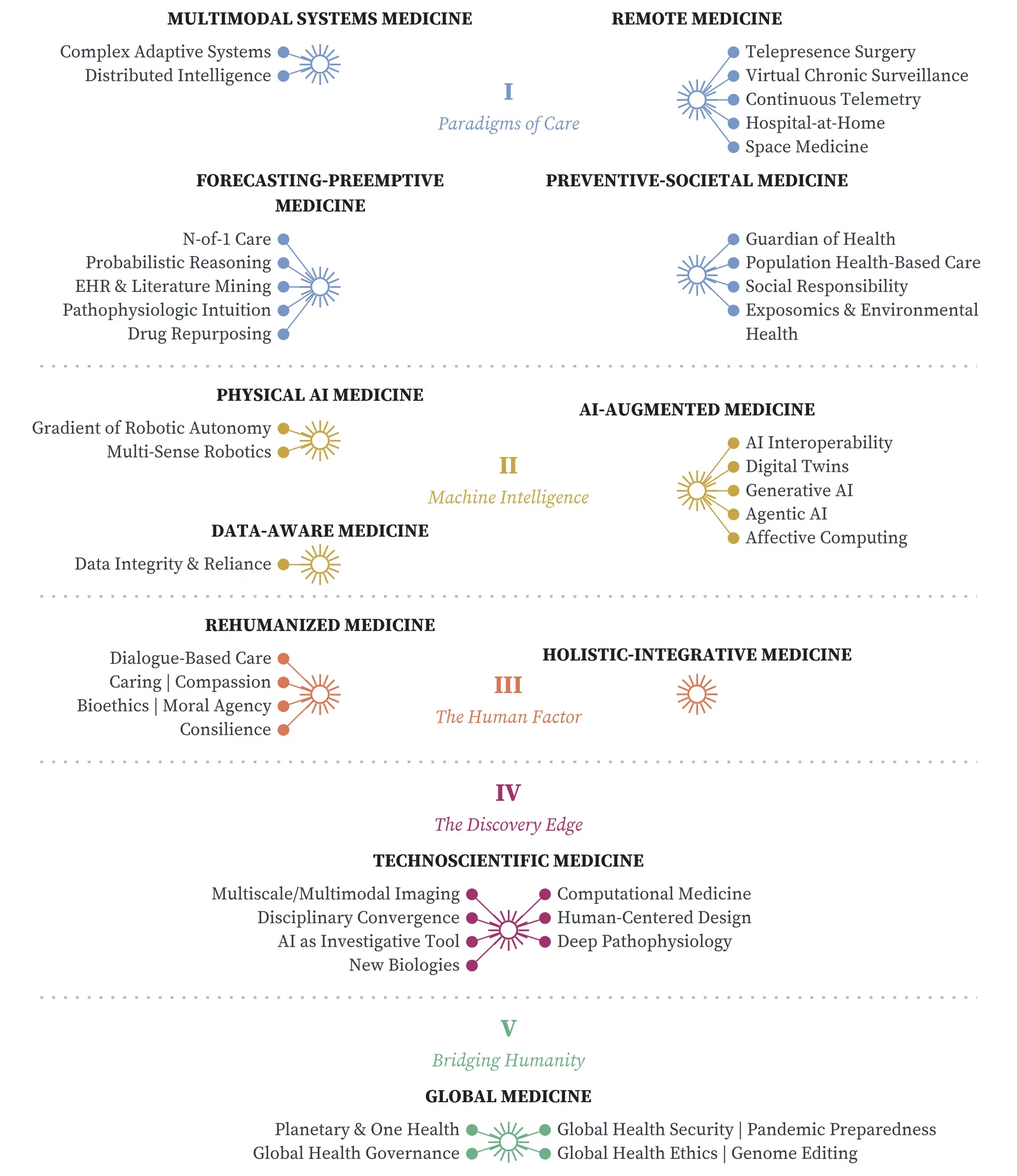
Eleven modes of medicine now operate at once, and Exhibit 3.1 groups them into five clusters. Each cluster answers a different question about care, and together they stand in a definite relation: one generates, one operationalizes, one delivers, one governs, and one bounds.
Cluster I, Paradigms of Care, contains four modes, best understood as one movement observed along four axes. Multimodal systems medicine changes the structure of care. It treats the patient, the disease, and the delivery system alike as complex adaptive systems whose behavior emerges from interaction, and which are therefore run by distributed intelligence, not by a single mind. Remote medicine changes the place of care, as telepresence surgery, virtual chronic surveillance, continuous telemetry, hospital-at-home, and space medicine each sever a clinical function from the building that used to house it.
Forecasting-preemptive medicine changes the time of care, moving intervention earlier than symptom through N-of-1 reasoning, probabilistic inference, EHR and literature mining, pathophysiologic intuition, and drug purposing. And preventive-societal medicine changes the scale of care, extending the physician's remit from the person to the population through the guardian-of-health role, population health-based care, social responsibility, and exposomics.
Two of these have crossed from proposition to evidence recently enough that the crossing is easily missed. Hospital-at-home is no longer a pilot. The United States federal evaluation of the Acute Hospital Care at Home initiative found lower mortality than in matched inpatient episodes, and a subsequent large comparative-effectiveness study found lower in-hospital mortality and lower emergency department use within thirty days of discharge at comparable cost.6 The hospital is becoming a service delivered around a patient. It ceases to be a place to which a patient is moved.
Exposomics has quietly relocated the largest available lever. Current estimates attribute the substantial majority of chronic disease risk, with figures of seventy to ninety percent cited, to non-genetic environmental exposure accumulated across a lifetime.7 If that is even approximately right, the most consequential determinants of the outcomes physicians are held accountable for lie outside the encounter entirely.
If most of what determines an outcome is set by exposure accumulated outside the clinic, then the physician is being held to account for a variable the encounter barely touches, and only two resolutions are available.
Either the remit expands to reach the determinants, taking in the built environment, occupational exposure, food systems, air, and the policies that govern them, or accountability contracts to match the actual lever, and the physician answers for the management of illness rather than for its incidence. The profession has not chosen between them, and in practice has done neither, retaining the accountability while declining the remit. Chapter X argues for the first resolution and describes what taking it seriously would require. The second is what happens by default, and it is a quiet diminishment.
Continuity of this kind has an unglamorous corollary. If care is continuous, the hours during which it is delivered cannot remain those of a nineteenth-century working day. Provider schedules will move toward substantially greater flexibility as organizations adjust services to when people actually need them, a shift already visible across other professional fields. It will likely arrive in medicine through patient expectation, not professional choice. The workforce implications are among the first things the model will test.
If the patient, the disease, and the delivery system are complex adaptive systems, then improvement is not additive. An intervention that works in isolation may be neutralized, or reversed, by the feedback it provokes elsewhere. This is why care-model change so reliably produces effects nobody designed. The competence that matters is less the ability to select an intervention than the ability to anticipate what a system will do in response to being intervened upon, a discipline Chapter IV treats as clinical, not theoretical.
A system that is structurally distributed, spatially unbounded, temporally anticipatory, and demographically scaled is not the clinic with additions. It is a different object, and it fails differently. The twentieth-century failure was the patient who could not reach care. Cluster I at its worst is omnisurveillance: the patient continuously monitored, statistically anticipated, demographically accounted for, and never actually seen.
Cluster II, Machine Intelligence, contains three modes that form a stack rather than a set. Data-aware medicine is the substrate: data integrity, provenance, and the calibration of reliance. AI-augmented medicine is the inference layer: AI interoperability, digital twins, generative AI, agentic AI, and affective computing. Physical AI medicine is the action layer: the gradient of robotic autonomy and multi-sense robotics, taken up in Chapter IV.
Cluster III, The Human Factor, contains rehumanized medicine, which is to say dialogue-based care, caring, compassion, bioethics, moral agency, and consilience, together with holistic-integrative medicine. These are usually treated as the soft appendix to a technical list. They are better understood as the only cluster that supplies a criterion, since the others describe what medicine will be able to do. This one asks what any of it is for, and by what standard a proposed change counts as an improvement. The two modes within it are also two senses of one word. Holistic-integrative medicine integrates the parts of a person that specialization divided, and rehumanized medicine integrates the persons, physician and patient, that efficiency separated. Neither integration is achieved by performing the other.
Cluster IV, The Discovery Edge, contains technoscientific medicine: multiscale and multimodal imaging, disciplinary convergence, AI as investigative tool, the new biologies, computational medicine, human-centered design, and deep pathophysiology. It appears in the exhibit as one mode among eleven, which understates it. This is the cluster that manufactures the others, Chapter II re-entering the clinical frame, and every capability the remaining clusters deliver, govern, or distribute originates in it. Its position in the exhibit is horizontal. Its actual relation to the rest is vertical.
Cluster V, Bridging Humanity, contains global medicine: planetary and One Health, global health governance, global health security and pandemic preparedness, and global health ethics including genome editing. It functions as the boundary condition on everything else. Pathogens, data, models, and inequities do not respect jurisdiction, and a mode of care validated in one health system is not thereby validated in another, which is the argument Chapter X develops.
Where a new capability lands in this constellation is not a property of the capability. Three things decide it, and all three are administrative. The first is the reimbursement category into which the technology can be coded, since a capability that can be billed as an imaging study enters as imaging whatever else it does. The second is its regulatory classification, which sets the evidence it must carry and therefore which institutional actor is willing to sponsor it. The third is which specialty already owns the adjacent workflow, because the adjacent owner acquires the new thing by default and rarely gives it back.
None of the three tracks clinical logic, which is why comparable technologies enter through different doors in different health systems. A leader who wants a capability to arrive in one cluster rather than another has three levers to work with, and they are available years before the technology is ready to deploy.
The five clusters prove to be sequential in a way the exhibit's geometry conceals. The Discovery Edge generates. Machine Intelligence operationalizes. The Paradigms of Care deliver. The Human Factor governs the encounter in which delivery actually occurs. And Bridging Humanity bounds the whole. Each carries a characteristic failure: discovery that never converts; inference resting on inadequate data; delivery that loses the patient; an encounter reduced to a transaction; and a solution that does not travel. A physician trained inside one cluster will be well equipped to recognize four of these failures in other people and none in themselves.
This is also where Chapter II reconnects. Next-wave theranostics are not a twelfth mode. They are the payload the modes will carry, and the matrix predicts the order of arrival. The emerging column enters through forecasting-preemptive medicine, since a therapy that senses a condition and responds to it is a prediction made physical.
The frontier column, with its AI-orchestrated digital-twin therapeutics and autonomous bioelectronic implants, enters through the machine-intelligence stack and is delivered remotely, which is to say it lands in two clusters at once and belongs administratively to neither. The visionary column arrives first as a governance and ethics problem, in Clusters III and V, long before it arrives as a therapy. Where a technology enters the matrix largely determines who ends up accountable for it.
How physicians will relate to each of these modes is the subject of the chapters that follow. No single mode will dominate. These are facets of one system, not alternatives among which a system chooses, present simultaneously and in varying proportion. A physician trained for one mode will therefore be trained for a minority of the future and, worse, will lack the vocabulary to notice which parts of it are missing.
Notes
- 6Centers for Medicare & Medicaid Services, Report on the Study of the Acute Hospital Care at Home Initiative (Washington, DC, 2024); Adams D. et al., "Initial findings from an Acute Hospital Care at Home waiver initiative," JAMA Health Forum 4 (2023): e233667; "Outcomes associated with hospital at home vs traditional inpatient stay," JAMA Network Open (2026).
- 7Christopher P. Wild, "The exposome at twenty: a personal account," Exposome 5, no. 1 (2025): osaf003; "Shaping the future of exposome science through analytical and computational advances," Exposome 6, no. 1 (2026): osag005.
Ideas on this section
No ideas linked here yet. Propose an extension, a counterpoint, or a way to test a claim.
Discussion
Annotate this section — questions, counterpoints, references.
No comments yet. Start the thread.