The Translational Gap
Translational gaps are one of the great opportunities of the coming decades, and one of the places where the physician's absence costs most.
Translational gaps are one of the great opportunities of the coming decades, and one of the places where the physician's absence costs most.
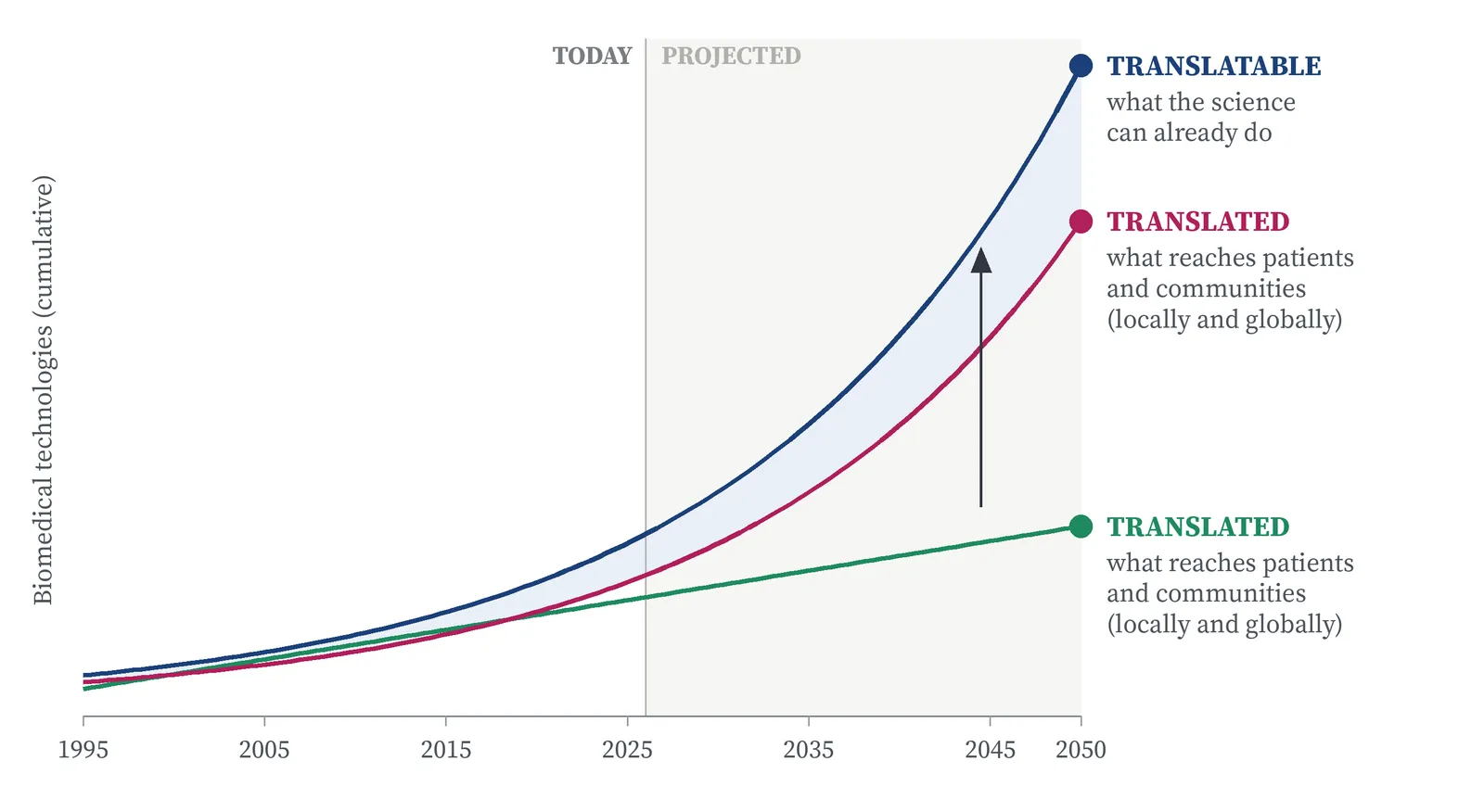
The gaps are properly understood as three nested ones. The first is translating fundamental biomedical insight into clinical diagnostics and therapeutics. The second is translating clinical innovation into population health recommendations and policy. The third is translating best-practice population health into the service of global health.
They fail differently. The first is a gap of conversion: mechanism understood but never made into anything a clinician can use. The second is a gap of aggregation: interventions that work for individuals but never become policy that works for populations. The third is a gap of transfer: practice established in one setting and never adapted to those that need it most. The first is upstream, and this report examines it in most detail.
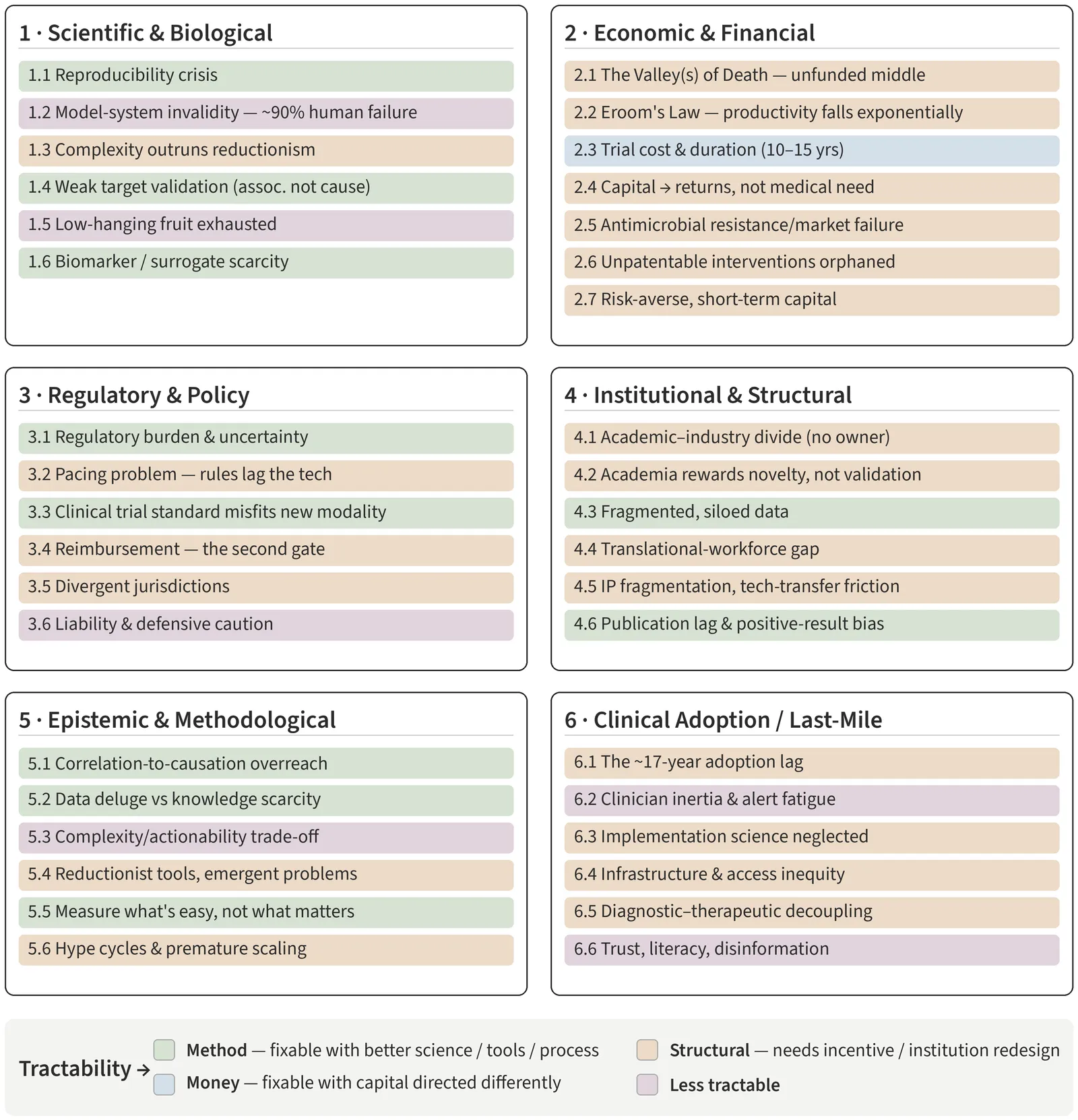
Three domains concern the science and how we reason about it. Scientific and biological drivers include the reproducibility crisis, model-system invalidity with its roughly ninety percent human failure rate, complexity outrunning reductionism, and biomarker scarcity, all answered by treating validation as a first-class scientific activity.
Epistemic and methodological drivers include correlation-to-causation overreach and the complexity-actionability trade-off, in which the truer the model, the harder it is to act on, answered by explicit training in causal reasoning. Regulatory and policy drivers include the pacing problem and trial standards that misfit new modalities, answered by modality-matched pathways, while conceding that not all of this gap should close, since some friction is the price of a working safety system.
Three further domains concern the machinery rather than the science. Economic and financial drivers include the unfunded middle between discovery and product, capital that follows returns, and the orphaning of unpatentable interventions, answered by mission-aligned capital and public purchase commitments where a market cannot form. Institutional and structural drivers include an academic-industry divide in which no actor owns the whole path, rewards for novelty, siloed data, and a thin translational workforce, answered by making translation a career. Clinical adoption drivers include the seventeen-year adoption lag and access inequity, answered by treating adoption as a designed process.
The distribution is the finding. Of the cataloged drivers, roughly seventeen are structural, eleven method-fixable, four money-fixable, and only about five intractable. The translational gap is overwhelmingly a made problem, not a found one.
Made problems have authors. If seventeen of the drivers are structural, then the structure was built, is maintained, and rewards someone for its maintenance. The beneficiaries are visible: journals that prize novelty over confirmation; promotion committees that count first papers, not converted ones; funders whose mandate ends where a product begins; institutions that hold data as an asset instead of a commons; and firms with no reason to develop what cannot be owned. None of these parties intends the gap. Each is responding rationally to its own incentives, and the gap is the sum of those responses. Naming them is not an
accusation but a precondition, because a problem attributed to the difficulty of nature is endured, while a problem attributed to a distribution of incentives can be renegotiated. That renegotiation is a coordination task among parties who at present have no forum in which to meet, which is the fragmentation Chapter XII takes up.
Others diagnose the gap differently. The European Commission's 2025 proposal reads it principally as financing and regulatory friction, contrasting some €219 billion of health-biotechnology venture capital raised by United States start-ups between 2015 and mid-2025 against €25 billion in the European Union, and prescribes faster pathways and late-stage capital.4 Those are real constraints, but on the analysis here they address the smallest of the four categories.
One further point governs all three gaps: each contains an irreducible element that AI cannot close. Machine systems can propose, screen, simulate, and monitor. They cannot decide that a candidate is worth the risk to a particular person. That judgment is made under uncertainty by an agent who can be held to account, and as AI absorbs the conversion work, that residue concentrates.
That concentration generalizes well beyond translation. Automation does not dilute the human contribution by removing pieces of it. It distills the contribution, by removing everything that can be specified. What remains is a smaller share of the work and a larger share of its consequence, since the decisions left over are those that no procedure settles. The physician's value therefore rises as machine capability rises, not in spite of it, provided the profession recognizes what it is being left with and prepares for that, instead of for what is being taken away.
As understanding of human biology and pathogenesis deepens at a fundamental level, physicians must be enabled to drive discovery and to address the clinical translation gap. Beyond serving as an empowered explorer and designer, the physician must be positioned to work through the bioethical complexities of frontier theranostic technologies and their associated regulatory frameworks. The biomedical research enterprise must itself be reconfigured to better address the theranostic opportunities unfolding before us, along the six lines set out in Chapter VII.
The translational gaps are multifactorial but addressable, and physicians need to be unleashed and empowered as key drivers of that effort. A gap largely made rather than found can be unmade, by people who stand on both sides of it.
Having surveyed what the science will make possible, we turn to the forms of care through which any of it will actually reach a patient.
Notes
- 4Department for Science, Innovation and Technology, National Vision for Engineering Biology (London: HM Government, December 2023); House of Lords Science and Technology Committee, report on seizing the opportunity of engineering biology (London, 2025); European Commission, Proposal for a Regulation establishing a framework of measures for strengthening the Union's biotechnology and biomanufacturing sectors, particularly in the area of health (European Biotech Act), COM(2025) 1022 final (Strasbourg, 16 December 2025).
Chapter II recommendation
Recommendation. Empower physicians to drive discovery and leverage clinical insight into innovation of frontier theranostic technologies. Recognize the physician as uniquely positioned to address the web of structural drivers responsible for the three translational gaps (Gap of Conversion: mechanism understood but never made into anything a clinician can use; Gap of Aggregation: interventions that work for individuals but never become policy that works for populations; Gap of Transfer; innovations that fail to globalize), understanding that as the space of possible theranostics expands, these gaps widen faster still. Make bioethical and regulatory fluency a core competency brought forward to the point of initial design, in the face of bioethically complex interventions with profound implications for humankind. Fund validation as a first-class scientific activity, with careers attached to it.
Ideas on this section
No ideas linked here yet. Propose an extension, a counterpoint, or a way to test a claim.
Discussion
Annotate this section — questions, counterpoints, references.
No comments yet. Start the thread.