Theranostics: Near-Term to Visionary
As the space of potential theranostics vastly expands, the clinical translational gap widens even faster. The physician should be positioned to help fill that gap, which requires fluency in what is coming.
As the space of potential theranostics vastly expands, the clinical translational gap widens even faster. The physician should be positioned to help fill that gap, which requires fluency in what is coming.
Exhibit 2.2 arranges six domains of next-wave theranostics against three horizons. Across a row, each capability tells one story in a different substrate: it begins as a targeted molecule, becomes a programmable system, then an autonomous one. Down the columns, coupling to human control loosens, which is why the visionary column carries the heaviest bioethical load.
In genetic code editing, programmable nucleic acid and mRNA therapeutics are already emerging; epigenetic landscape sculptors sit at the frontier; higher-order chromatin and 3D genome topology editors remain visionary. The progression is instructive, running from editing sequence, to regulation, to architecture, and the same logic recurs down every row: edit the part, then the program that governs it, then the structure it runs within.
Two examples from the emerging column, five to ten years out, show how near this is. Synthetic cellular immunotherapies and living medicines are cells engineered to sense a condition and respond to it, so that the therapy is an agent with a policy. Targeted proteolysis and molecular degraders remove a pathogenic protein, converting targets long written off as undruggable into ordinary ones.
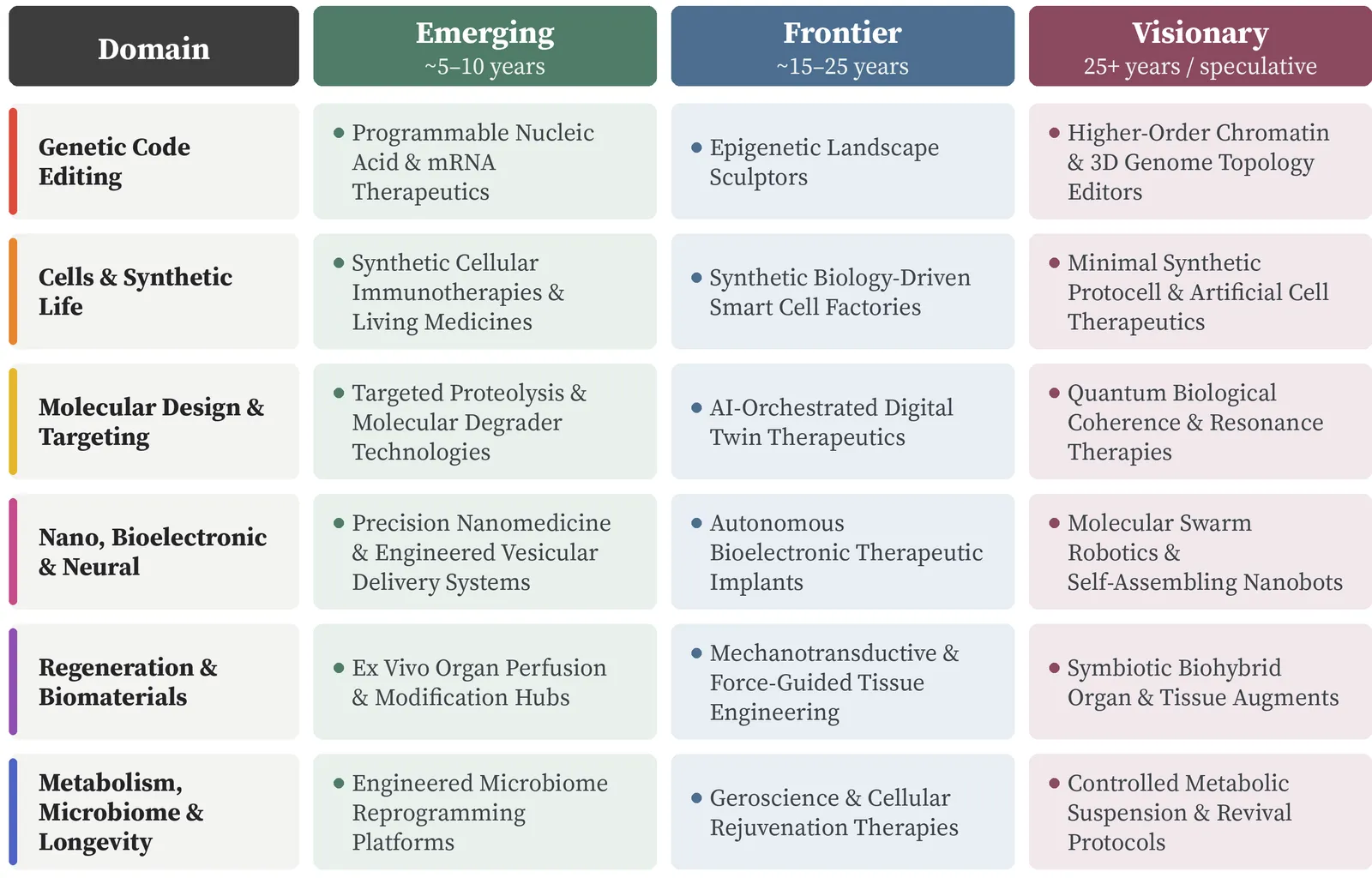
Two from the frontier column show where the physician’s role changes. AI-orchestrated digital-twin therapeutics titrate an intervention against a continuously updated model of the patient, the subject of Chapter V, so that a prescription becomes a control loop instead of a single decision. Autonomous bioelectronic implants sense and stimulate without instruction, and in both the question shifts from what to give to what the system may decide.
And two from the visionary column mark the outer edge of plausibility. Molecular swarm robotics and self-assembling nanobots imagine agents that assemble in situ and act collectively. Symbiotic biohybrid organ and tissue augments imagine composites that are neither prosthesis nor graft. Some will not arrive on the suggested timeline, and they are included anyway, because a vision containing only what is certain is not a vision.
Four developments at the cutting edge show what integration in the strict sense looks like.
- Theranostic digital twins. In radiopharmaceutical therapy, where one molecule can be labeled for imaging and for treatment, a patient-specific model built from serial imaging lets dosimetry be individualized.5
- AI-integrated nanomedicine. Delivery vehicles designed computationally against an individual's tumor characteristics, with the reporting function built into the particle.
- Closed-loop theranostic systems at the photonics–AI interface. Optical and acoustic sensing coupled in real time to energy-based ablative therapies, so that the margin is read while the energy is delivered.
- Integrated diagnostics in precision oncology. Radiology, pathology, and molecular profiling consolidated into a single interpretive output: less a technology than the organizational precondition for the rest.
Underneath all four sits a measurement capability that is easy to underestimate because it already exists. Multiplexed aptamer platforms today detect upwards of ten thousand analytes from a single drop of blood. Within the horizon of this report that capability should extend beyond blood to saliva, tears, and urine, and compress from hours to minutes.
The harder half is interpretive rather than analytic. At present we largely do not know what a three-hundred-and-sixty-degree measurement of a person means, and the value of the technology depends on that gap closing at a comparable rate. A theranostic loop is only as good as the reading that triggers it.
An interpretive deficit is an academic limitation only while a human sits between the reading and the response, deciding whether the finding is real and whether it warrants acting on. Close the loop and that pause disappears: the system acts on a reading no one can yet interpret, at machine speed, and the first evidence that the interpretation was wrong is the patient's response to a therapy already delivered.
Uninterpretable measurement is tolerable. Uninterpretable measurement wired directly to an actuator is a safety problem, and a new one, since the errors it produces will resemble neither the errors of diagnosis nor those of treatment as the profession has learned to recognize them. This is the first appearance of a requirement that recurs throughout this report: validation must hold at every layer of a system, not at its output alone. Chapter IV treats that discipline as clinical work.
That is why the physician's contribution moves upstream. What next-wave theranostics share is the collapse of the interval between knowing and acting, which is where clinical judgment has traditionally been exercised. The judgment is not thereby retired. It relocates into the governance of the loop: what it may sense, what it may do, and when it must stop and ask.
Notes
- 5"Theranostic digital twins: concept, framework and roadmap towards personalized radiopharmaceutical therapies," Theranostics 14 (2024): 3404--3422.
Ideas on this section
No ideas linked here yet. Propose an extension, a counterpoint, or a way to test a claim.
Discussion
Annotate this section — questions, counterpoints, references.
No comments yet. Start the thread.