New Biologies
Two things are happening at once in the life sciences, and they compound each other: a deepening of mechanism, as our grasp of how living systems work resolves at ever finer spatiotemporal scale, and a dramatic extension of technical power.
Two things are happening at once in the life sciences, and they compound each other: a deepening of mechanism, as our grasp of how living systems work resolves at ever finer spatiotemporal scale, and a dramatic extension of technical power. What can be measured can increasingly be modulated, and what can be modulated can increasingly be designed.
Out of that compounding, new biologies are crystallizing: emergent knowledge domains carrying considerable translational potential.
The National Academies of Sciences, Engineering, and Medicine framed the field in its 2025 report A Vision for Continental-Scale Biology, which argued for biology conducted across nested scales, from molecules to organisms to ecosystems to continents, supported by shared infrastructure and interoperable data.2 That report looks outward, toward the biosphere.
The inward-facing literature of the same period is real but fragmented: single-field roadmaps for RNA modifications and for digital twins; a biosecurity assessment of AI-enabled biological tools;3 and national instruments such as the United Kingdom's National Vision for Engineering Biology and the European Commission's proposed Biotech Act, which treat the same science as an industrial problem.4 None takes the new biologies as a set. None asks who converts them.
This report accepts the continental-scale argument and turns it inward, to the single patient, where the same instruments and the same cross-scale reasoning are required and where a human being must finally act. It takes the new biologies as a set, and it answers the question the rest of the literature leaves open. The answer defended here is the physician.
These biologies are less branches of a discipline than competing answers to a prior question, namely what a biological explanation now consists of. Systems biology asks how components behave as an integrated whole. Computational biology turns biological questions into tractable algorithms. Digital biology renders life as manipulable information. Structural biology reads function from three-dimensional form. Network biology treats disease as a property of connection, not of any single node. Generative biology designs sequences evolution never produced. Synthetic biology builds to specification. Regenerative biology asks what instructs tissue to rebuild itself.
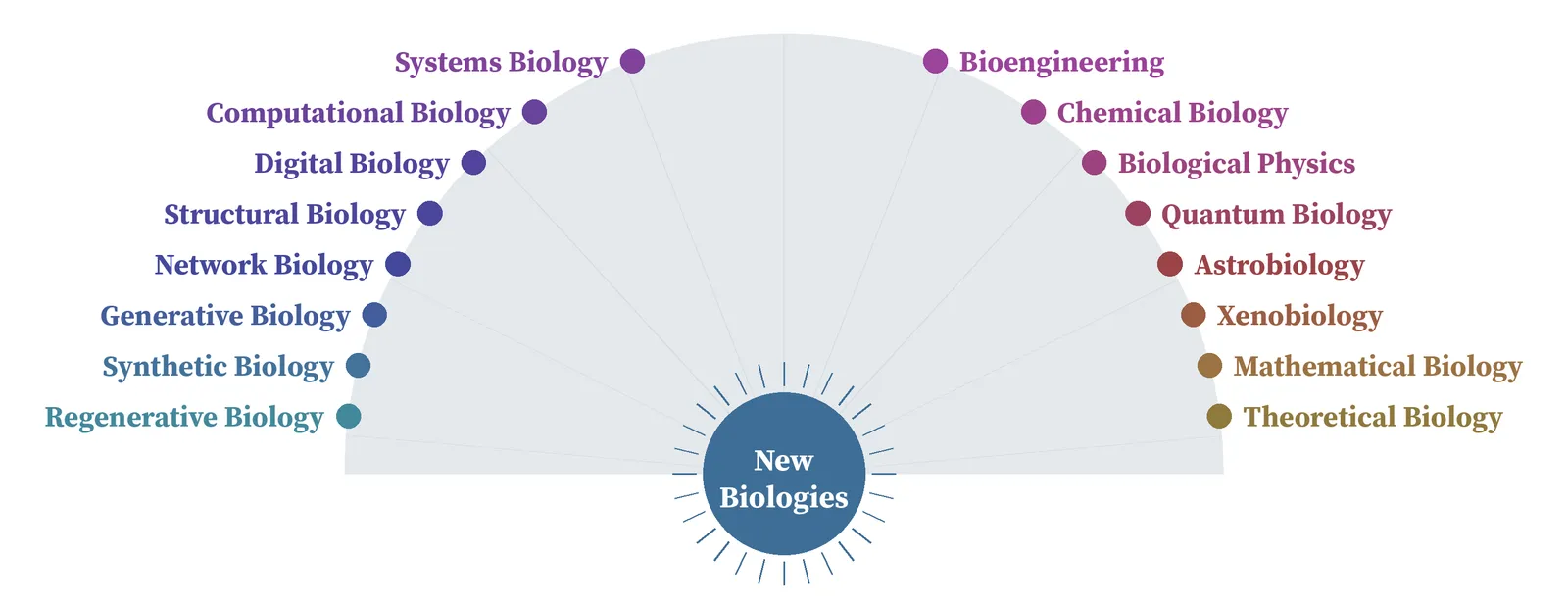
Further from the clinic, and too easily dismissed for that reason, sit eight more. Bioengineering imposes engineering discipline on living material; chemical biology rewires cells with purpose-built small molecules; biological physics seeks the constraints living matter cannot escape; quantum biology asks whether coherence and tunnelling do real work in enzymes. Astrobiology asks what life is by asking where else it could be; xenobiology builds life on chemistries the biosphere never used; mathematical biology supplies the language of growth and scaling; and theoretical biology asks what must be true of any living system at all.
The most mind-bending territory lies where biology meets physics and mathematics, where the field’s deepest questions sit: why living systems are organized as they are, and what limits any intervention must respect. The vocabulary of medicine is thinnest there.
These categories are not discrete. They overlap, and the overlaps are where the productive work is, since each pairing spawns a derivative subfield within a few years. Computational and structural biology yield predictive protein design. Systems and network biology yield interactome medicine. Digital and mathematical biology yield the virtual cell. Exhibit 2.1 is best read as a set of axes rather than of bins, because the unit of fluency is a combination.
One convergence in that space has not yet been named. Where bioengineering meets the complexity sciences, the design assumptions themselves change, because the material is adaptive, error-prone, nonlinear, and generally operating close to a threshold, so that specifying an end state and driving the system to it is not available as a method. What replaces it is the design of selective context and of the distribution of outcomes, which is a different discipline with a different success criterion.
Call it emergent bioengineering. It already runs through several of the biologies named above. Generative and synthetic biology both design for living material that will go on evolving after the design is finished, and regenerative biology instructs a tissue instead of building one. Chapter IX develops it as a working idea for the clinic.
The stage is being set in real time, and often from unexpected directions. The work of John Higgins at Harvard and Massachusetts General Hospital is a compact illustration. Rather than seeking new measurements, his laboratory applies dynamical systems theory to measurements hospitals already make by the million, modeling the population dynamics of circulating blood cells: how red cells change in size and hemoglobin content across their four-month lifespan, and how those dynamics shift under disease.
From an ordinary complete blood count the models extract parameters that are not directly measurable, which has yielded a means of predicting who will become anemic before they do, a mechanistic account of hemoglobin glycation that permits genuinely personalized diabetes monitoring, and risk stratification for acute coronary syndrome from white-cell dynamics. The diagnostic content was latent in tests already being run, and what was missing was a model of the underlying process. That is the new biologies in immediately deployable form, at the intersection of systems and digital biology.
The principle reaches well beyond blood counts. The scarce capacity in that work was the modeling insight to see what existing measurement already contained. Access to new measurement was not the constraint. Hospitals had been running those tests by the million for decades; what was missing was a description of the process generating the numbers.
Discovery of this kind requires no new apparatus, no cohort to assemble, and little capital, which makes it unusually available to physicians, who sit closer than anyone to the data exhaust of ordinary care and know which of its regularities would matter if they were understood. That availability is the practical basis for a claim this report develops in Chapter VII, that discovery can be a normal part of clinical life and need not remain the property of a separate profession.
Notes
- 2National Academies of Sciences, Engineering, and Medicine, A Vision for Continental-Scale Biology: Research Across Multiple Scales (Washington, DC: The National Academies Press, 2025).
- 3National Academies of Sciences, Engineering, and Medicine, Charting a Future for Sequencing RNA and Its Modifications: A New Era for Biology and Medicine (Washington, DC: The National Academies Press, 2024); National Academy of Engineering and National Academies of Sciences, Engineering, and Medicine, Foundational Research Gaps and Future Directions for Digital Twins (Washington, DC: The National Academies Press, 2024); National Academies of Sciences, Engineering, and Medicine, The Age of AI in the Life Sciences: Benefits and Biosecurity Considerations (Washington, DC: The National Academies Press, 2025).
- 4Department for Science, Innovation and Technology, National Vision for Engineering Biology (London: HM Government, December 2023); House of Lords Science and Technology Committee, report on seizing the opportunity of engineering biology (London, 2025); European Commission, Proposal for a Regulation establishing a framework of measures for strengthening the Union's biotechnology and biomanufacturing sectors, particularly in the area of health (European Biotech Act), COM(2025) 1022 final (Strasbourg, 16 December 2025).
Ideas on this section
No ideas linked here yet. Propose an extension, a counterpoint, or a way to test a claim.
Discussion
Annotate this section — questions, counterpoints, references.
No comments yet. Start the thread.