Biomedical Digital Twins
The most concrete instrument yet devised for closing distance to the individual is the digital twin.
The most concrete instrument yet devised for closing distance to the individual is the digital twin.
The term has a traceable and surprisingly recent history, and knowing it clarifies what a twin is and is not. The concept was introduced by Michael Grieves in 2002, in a presentation at the University of Michigan on product lifecycle management, where it appeared as the Mirrored Spaces Model and later as the Information Mirroring Model. The phrase digital twin itself was coined by John Vickers of NASA around 2010, and Grieves adopted it thereafter; the two set out the mature formulation jointly in 2017.19
Its ancestry runs further back, to NASA's Apollo-era practice of keeping a physical duplicate on the ground to mirror a vehicle in flight, and to David Gelernter's 1991 Mirror Worlds. Medicine adopted the term late, and imported with it a discipline clinical modeling often lacked: a twin is defined by its live connection to a specific physical object, not by its fidelity as a picture.
Exhibit 5.2 sets out the pipeline from generating a twin to using it, in three stages.
The inputs. Six modalities feed the twin, and the list is deliberately broader than the omic profile that usually stands in for personalization: clinical records and laboratory data; imaging across MRI, CT, PET, echo, and histopathology; molecular multi-omics; physiological signals from ECG, EEG, and wearables; and behavioral and exposome data. The sixth, and the one most often omitted, is mechanistic priors: the pharmacokinetic and systems-pharmacology models constraining the twin where the patient's data is thin. That last input separates a twin from a curve fitted to a person.
The engine. Three operations run continuously. Fuse merges the modalities into a single coherent state estimate. Simulate tests candidate interventions against that state. Update re-fits the model from live signals, so that the twin tracks the patient instead of describing a moment now past. A twin that is not being updated has already become a historical document.
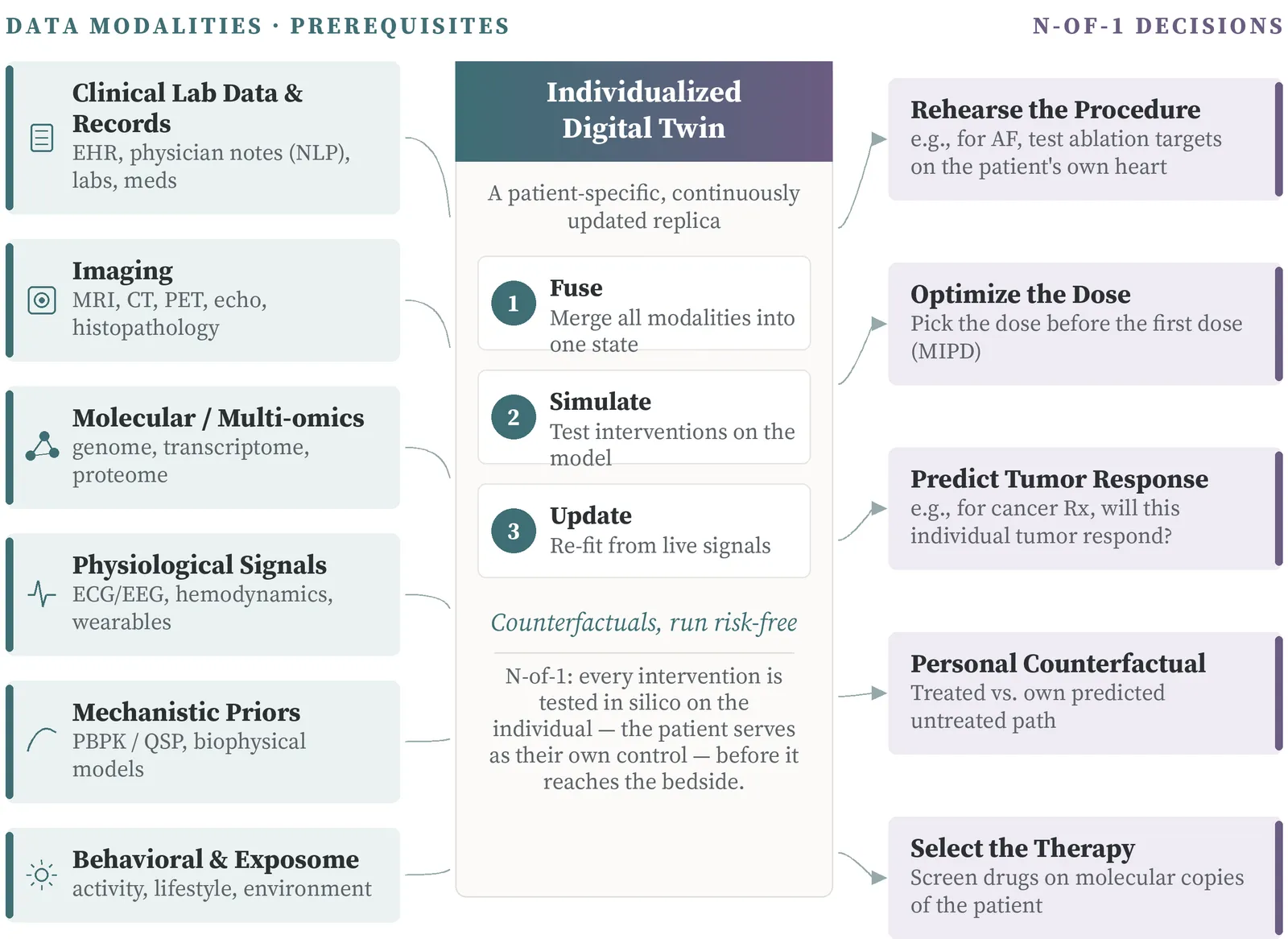
The outputs. Five classes of N-of-1 decision emerge. Rehearsing a procedure, by testing ablation targets on a model of this patient's own heart before entering the atrium. Optimizing the dose before the first dose is given, instead of titrating toward it. Predicting whether this individual tumor will answer this agent. Constructing the personal counterfactual, comparing the treated patient against their own predicted untreated trajectory. And selecting the therapy by screening candidate drugs against molecular copies of the patient.
The unifying move is stated in the exhibit itself: every intervention is tested in silico on the individual, who thereby serves as their own control, before it reaches the bedside. Counterfactuals become available at no risk, which is what clinical medicine has never been able to buy.
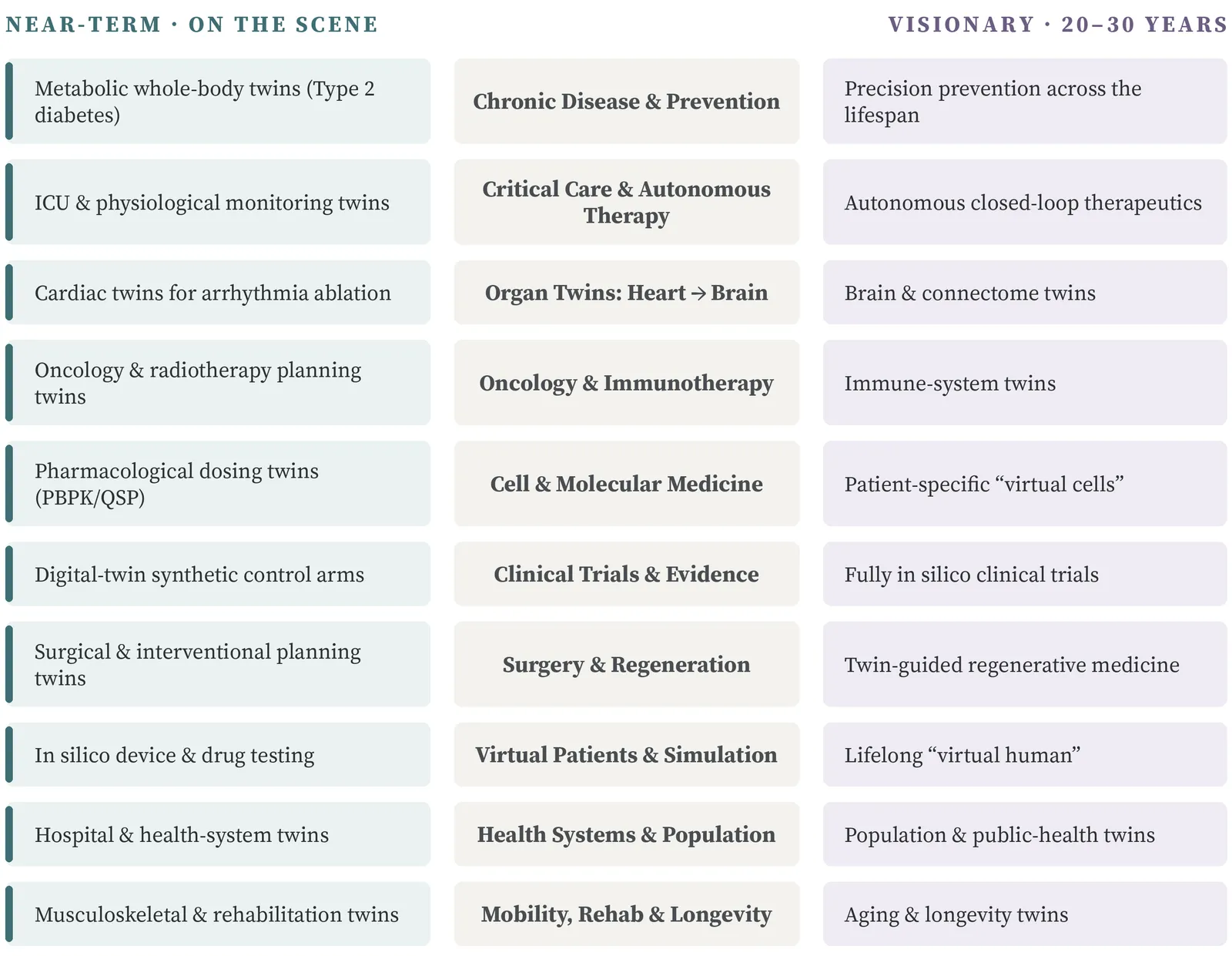
Exhibit 5.3 pairs what is already on the scene with what a twenty-to-thirty-year horizon might bring, across ten domains.
Two digital twin applications in the near-term category, far along in their development, are illustrative. Cardiac twins for arrhythmia ablation build a patient-specific electrophysiological model from imaging, simulate where re-entrant circuits will form, and identify targets before the catheter is placed, which is the clearest existing case of rehearsing a procedure on a person not yet on the table. Digital-twin synthetic control arms use modelled patients in place of a randomized control group, which matters most where randomization is hardest to justify: rare disease, pediatric populations, and conditions in which assignment to placebo is ethically strained.
Two visionary entries show where the same logic leads. Fully in silico clinical trials would generate regulatory-grade evidence on virtual cohorts, reserving human trials for what simulation cannot settle. The lifelong virtual human would initiate a twin at birth and maintain it across a life, so that every measurement is read against that person's own trajectory. The first is an evidentiary transformation, the second an epistemic one, dissolving the reference-class problem by making each person their own reference class.
One example shows how a twin converts a population-scale discovery into an individual decision. Biovista, founded by Andreas and Aris Persidis, has spent two decades building literature-based discovery into an industrial process: systems literature analysis treating the whole corpus as one interconnected system, a Clinical Outcome Search Space linking drugs, genes, diseases, pathways, and adverse events, and the augmented-intelligence platform Project Prodigy, which generates mechanistically reasoned hypotheses for purposing existing compounds against new indications.20 The output is a ranked set of drug-indication pairs with an explicit mechanistic argument attached.
It does not, and cannot, answer whether a candidate applies to the patient in front of the physician. That is the join. A purposing hypothesis carrying its own mechanistic rationale is the claim a digital twin can test. The proposed mechanism is checked against this patient’s pathway state, pharmacokinetics, comorbidity, and concurrent therapy, and the candidate is rehearsed in silico or discarded before anyone is exposed to it. Discovery at population scale, adjudication at the scale of one, with the physician at the junction.
This becomes a workflow question. The institution that holds the record should hold the twin, since a twin severed from the record it is calibrated against decays within months. It is built from the patient's own longitudinal data, supplemented by mechanistic models where the data is thin, with its provenance and its last revalidation recorded alongside it.
The in silico rehearsal enters the chart as what it is, a modeled prediction carrying its uncertainty, cited in the note as a reason and never as a result. Liability follows the rule that governs the rest of this report: the prediction is an input, the decision is the physician's, and the twin's builder answers for the model's fitness while the clinician answers for its use. None of this exists as a standard today. All of it is the kind of thing a consortium, not a single institution, would have to settle, which is the concrete object Chapter XII proposes federating around.
Engineering is not all that stands between the two columns. The National Academies’ 2024 assessment of foundational research gaps for digital twins is candid that data assimilation and inverse problems, uncertainty quantification, the ethics of decisions taken on a twin’s output, and the reliability of the twin itself remain open research questions.3 The technology is further advanced as a research instrument than as a clinical one.
These gaps are addressable, and the routes are known: shared validation benchmarks; uncertainty quantification alongside every prediction; hybrid mechanistic-plus-AI architectures that constrain models with physiology where data is thin; federated construction across institutions; regulatory pathways designed for continuously learning models; and deliberate inclusion of diverse populations from the outset.
A more fundamental limit underlies the engineering ones. A twin is a model, and a model is a generalization, so it represents the patient only in the respects it was built to represent. Improving it shrinks the reducible part of the N-of-1 gap, the part that was ignorance about this body, and leaves the other part untouched. As the twin absorbs more of the inference, the questions left to the physician are more purely those of value, tolerance, and meaning, which the model cannot pose, let alone answer. The instrument does not close the gap. It concentrates it, and in doing so makes clearer what the gap always was.
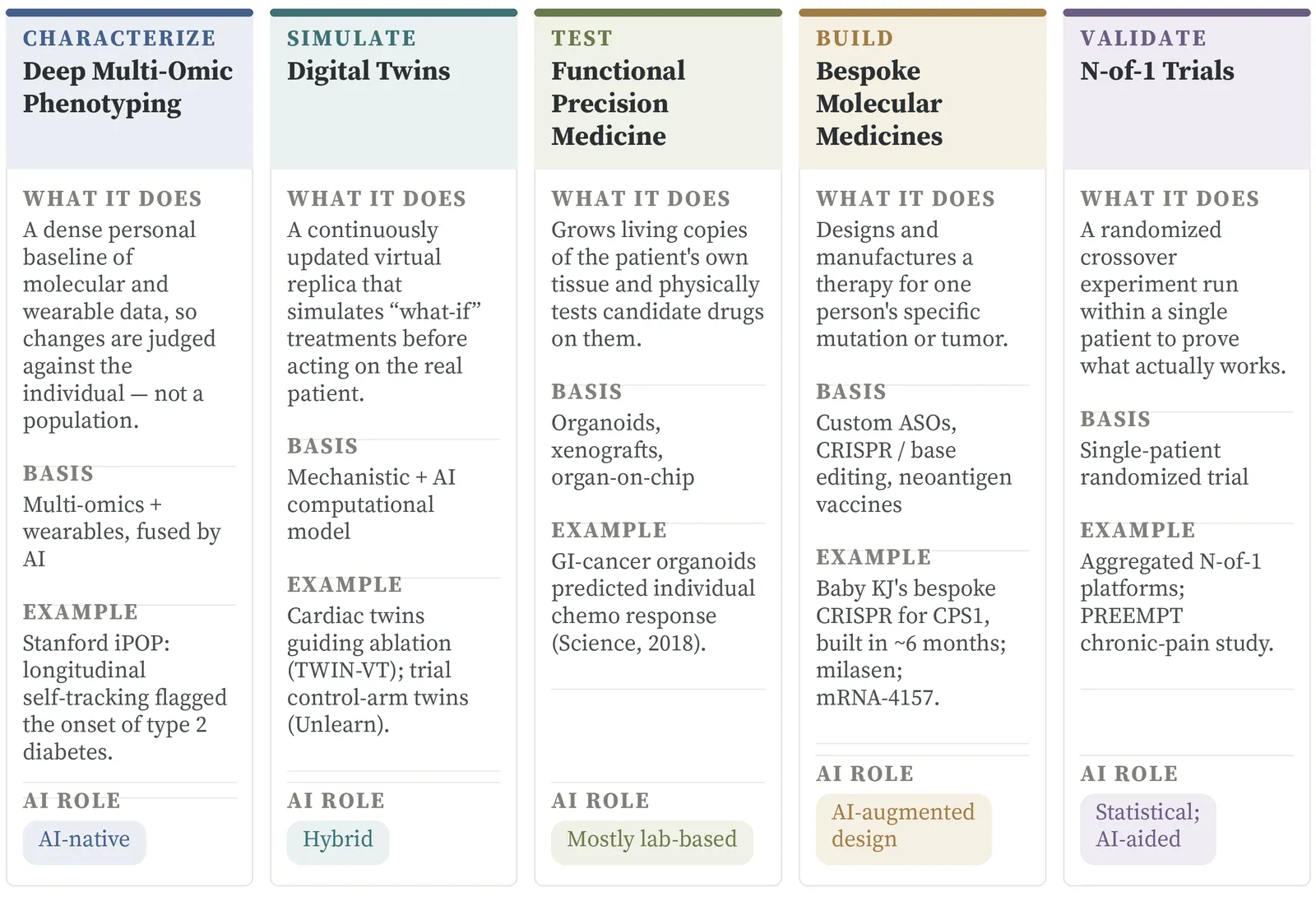
Digital twins, however, are only one of several AI-enabled routes to personalization, and Exhibit 5.4 sets out five that are complementary.
Notes
- 3National Academies of Sciences, Engineering, and Medicine, Charting a Future for Sequencing RNA and Its Modifications: A New Era for Biology and Medicine (Washington, DC: The National Academies Press, 2024); National Academy of Engineering and National Academies of Sciences, Engineering, and Medicine, Foundational Research Gaps and Future Directions for Digital Twins (Washington, DC: The National Academies Press, 2024); National Academies of Sciences, Engineering, and Medicine, The Age of AI in the Life Sciences: Benefits and Biosecurity Considerations (Washington, DC: The National Academies Press, 2025).
- 19Michael W. Grieves, "Conceptual ideal for PLM" (presentation, University of Michigan, 2002), later published as the Mirrored Spaces and Information Mirroring Models; Michael Grieves and John Vickers, "Digital twin: mitigating unpredictable, undesirable emergent behavior in complex systems," in Transdisciplinary Perspectives on Complex Systems, ed. Franz-Josef Kahlen et al. (Springer, 2017); David Gelernter, Mirror Worlds (Oxford University Press, 1991).
- 20Christos Andronis, Anuj Sharma, Vassilis Virvilis, Spyros Deftereos, and Aris Persidis, "Literature mining, ontologies and information visualization for drug repurposing," Briefings in Bioinformatics 12, no. 4 (2011): 357--368; Eftychia Lekka, Spyros N. Deftereos, Aris Persidis, Andreas Persidis, and Christos Andronis, "Literature analysis for systematic drug repurposing: a case study from Biovista," Drug Discovery Today: Therapeutic Strategies 8, nos. 3--4 (2011): 103--108.
Ideas on this section
No ideas linked here yet. Propose an extension, a counterpoint, or a way to test a claim.
Discussion
Annotate this section — questions, counterpoints, references.
No comments yet. Start the thread.