Pursuit of N-of-1 Medicine: Humans Fill the Irreducible Gap
For most of medical history the central challenge has been too little actionable information about the patient. Within the next decade it may be too much.
For most of medical history the central challenge has been too little actionable information about the patient. Within the next decade it may be too much.
Continuous data streams can build, test, and refine predictions unique to each patient, and interpretation then becomes the limiting factor. The defining question of the era is how to turn billions of data points into wisdom that helps a physician care for one human being.
The ambition travels under several names, and the vocabulary matters because the terms are not synonyms. Personalized and individualized medicine are the oldest and loosest. Precision medicine displaced them deliberately, to signal molecular stratification, not bespoke treatment, and stratified medicine names that activity more honestly. P4 medicine, in Leroy Hood's formulation, adds predictive, preventive, and participatory. Precision health widens the frame from disease to health across a lifespan. And single-case experimental designs, personalized trials, and individual-centered trials all denote the N-of-1 trial of Chapter IV. Precision medicine subdivides the population, and N-of-1 medicine is what remains when subdivision has nowhere further to go.
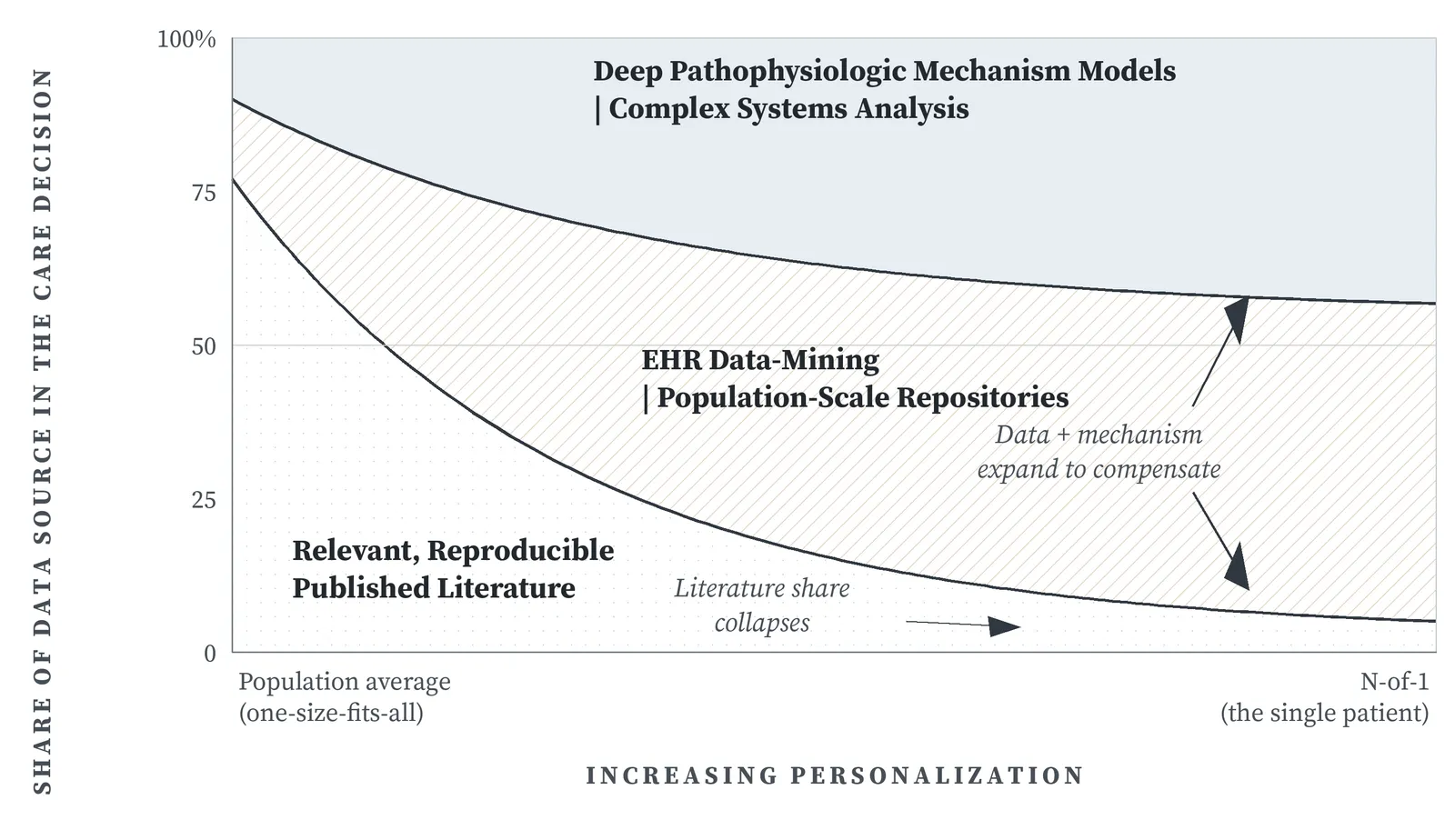
Exhibit 5.1 plots the share of each data source in the care decision as care moves from the population average toward the single patient. The enterprise contains a paradox.
As personalization increases, the band representing relevant, reproducible published literature collapses. The more precisely a condition is specified, the fewer comparable cases exist in the literature, and the more acute the problem of non-reproducible findings becomes, since small, underpowered, or unreplicated studies carry disproportionate weight precisely where evidence is thinnest.
Recent assessments of this ambition run far more sober than the enthusiasm of a decade ago. A 2025 analysis of the shift from precision interventions to precision health makes the awkward point that how precise a precision intervention actually is, in mechanism of action, in clinical effect, and in how many people it might benefit, is hard to anticipate from current preclinical and trial strategies, and that even ultra-precise, patient-specific interventions require serious experimental evaluation; inference from their design is not enough.18 Personalization is not self-validating. A therapy built for one person must still be shown to work in that person, which is a harder evidentiary problem than building it was.
A second obstacle is operational rather than evidentiary, and health systems will meet it first. Care specified to a single person appears irreconcilable with care delivered at scale, and the apparent contradiction has been enough to keep N-of-1 medicine filed under boutique practice.
It resolves in a way already visible in early forms. AI-enabled platforms can group patients dynamically by the features that actually matter for a given decision, allowing a physician to deliver partially shared care to a cohort assembled for the occasion and then continue individually where the paths diverge. That means a session held in common for what is common, followed by individual follow-up for what is not. Hybrid physical-virtual delivery, AI agents, and adaptive scheduling make such grouping practical in a way that fixed clinic structures never did. The grouping is not a return to stratified medicine, because the cohort is transient and formed around a specific question rather than a diagnostic label. What it buys is the scalability that personalization was assumed to forfeit.
One route to the ambition is already largely built, and it inverts the usual assumption that personalization requires a new molecule. Drug purposing, treated in Chapter II as a discovery method, becomes at the individual scale a real-time N-of-1 deliverable: matching an existing compound to this person, on this mechanistic rationale, within the timeframe of their care rather than that of a development program. A purposed compound arrives with its safety profile established, which is the single largest obstacle standing between an individualized hypothesis and an individualized treatment.
A second critique concerns deployment rather than concept. The National Academy of Medicine observed in 2024 that personalized trial designs, developed precisely to address heterogeneity of treatment effect, are still not part of the working arsenal of precision medicine. Clinicians confronting a patient who does not respond as the average did are therefore left extrapolating from group means by intuition.18 The instrument that would answer the question exists and is not deployed.
A third critique follows from Chapter IV. As measurements per patient rise, so do the comparisons from which a striking finding will be selected. More data does not automatically mean more truth about the individual, and it can mean more opportunities to be confidently wrong about them.
Those three critiques concern instruments and data, and the gap that remains is not of that kind. A complete description of a person, if such a thing existed, would still not decide what to do about them, because a decision requires a judgment about which of the available futures is worth pursuing and at what cost.
No quantity of information about a class determines an action toward a member of it. Evidence establishes what happened to people who resembled this one in specified respects; acting requires deciding that the respects in which they differ do not matter here, and that the outcome being sought is the one this person would choose. Neither step is an inference from data. Closing the information gap therefore cannot close this one, which is why it survives every improvement in measurement and will still be there when the measurement is complete.
Even as superintelligence is approached, truly personalizing medicine, and filling that gap, will require human judgment, intuition, and wisdom. This is the N-of-1 gap. It is irreducible.
Irreducible gaps set permanent ceilings. Computational undecidability limits what can be verified or predicted about sufficiently complex systems. Gödel incompleteness limits any formal system's self-description. The first-person character of experience resists third-person reconstruction. In the clinical case, the N-of-1 gap is the residue left when every generalization has been applied to a particular person who is not a member of any reference class.
Notes
- 18"From precision interventions to precision health," Nature Communications 16 (2025): 5024; National Academy of Medicine, "Expanding the role of N-of-1 trials in the precision medicine era: action priorities and practical considerations," NAM Perspectives (2024).
Ideas on this section
No ideas linked here yet. Propose an extension, a counterpoint, or a way to test a claim.
Discussion
Annotate this section — questions, counterpoints, references.
No comments yet. Start the thread.