An Embrace of Distributed Intelligence: Horizontal Care
The singular physician dissolves into distributed intelligence.
The singular physician dissolves into distributed intelligence.
A second term belongs alongside the first. Distributed cognition, as developed in the cognitive sciences, holds that knowledge is spread across many holders. It holds more than that: the cognitive work itself, the remembering, the representing, the reasoning, is carried by a system of people, instruments, and representations acting together, instead of occurring inside a single head and being communicated outward.
A horizontal care team is therefore not a set of individual thinkers who coordinate afterwards. It is one cognitive system whose components happen to include clinicians, machines, records, and protocols. The design question shifts accordingly, from how to keep each participant informed to how to arrange the system so that the reasoning it performs as a whole is sound.
A third term completes the set and names what the other two run on. Networked intelligence is the connected ecosystem through which knowledge actually moves: platforms, registries, repositories, and institutions exchanging what they hold dynamically instead of storing it in place. Distributed intelligence describes where knowledge sits. Distributed cognition describes where the thinking happens. Networked intelligence describes the channels along which both travel. The distinction is not academic, because a team can be fully distributed and still parochial if the channels are missing, which is the ordinary condition of medicine today: expertise dispersed across institutions that cannot readily exchange it.
An analogy from comparative neuroscience is loose but useful. The octopus carries roughly five hundred million neurons, a total in the neighborhood of that of a dog, but distributes about two thirds of them into its eight arms instead of concentrating them centrally. Each arm holds on the order of forty million neurons along an axial nerve cord, with ganglia near each of its several hundred suckers, and can taste, explore, grip, and respond locally without waiting on instruction from the central brain. Recent work describes that nerve cord as organized into repeating segments, giving the arm a modular architecture.
The animal is nonetheless one animal. The central brain sets goals, arbitrates, and integrates. The peripheral modules handle what is local and report upward. Neither full centralization nor full autonomy describes it.44
The physician's functions in such a system might be viewed as dual, since as an active caregiver the physician certainly represents one of the octopus arms. At once, the physician, as team coordinator, resembles the octopus's central brain, arbitrating where local signals conflict, and integrating what the periphery has already worked out.
None of this diminishes the other professions at the periphery; it describes what they become. Ann Kurth, who led the Yale School of Nursing before becoming the first nurse to head the New York Academy of Medicine, has argued that nursing, as the largest segment of the health workforce, should be understood as a full partner in system transformation rather than as an implementing arm of medicine. The barriers to nurses practicing to the full extent of their preparation, she argues, can be removed.
The physician's role changes location, not size. In a system where nurses, pharmacists, therapists, community health workers, and machine agents each hold genuine authority within their domains, the physician's contribution is integrative rather than supervisory, and it has to be earned in the way any partner's contribution is earned.
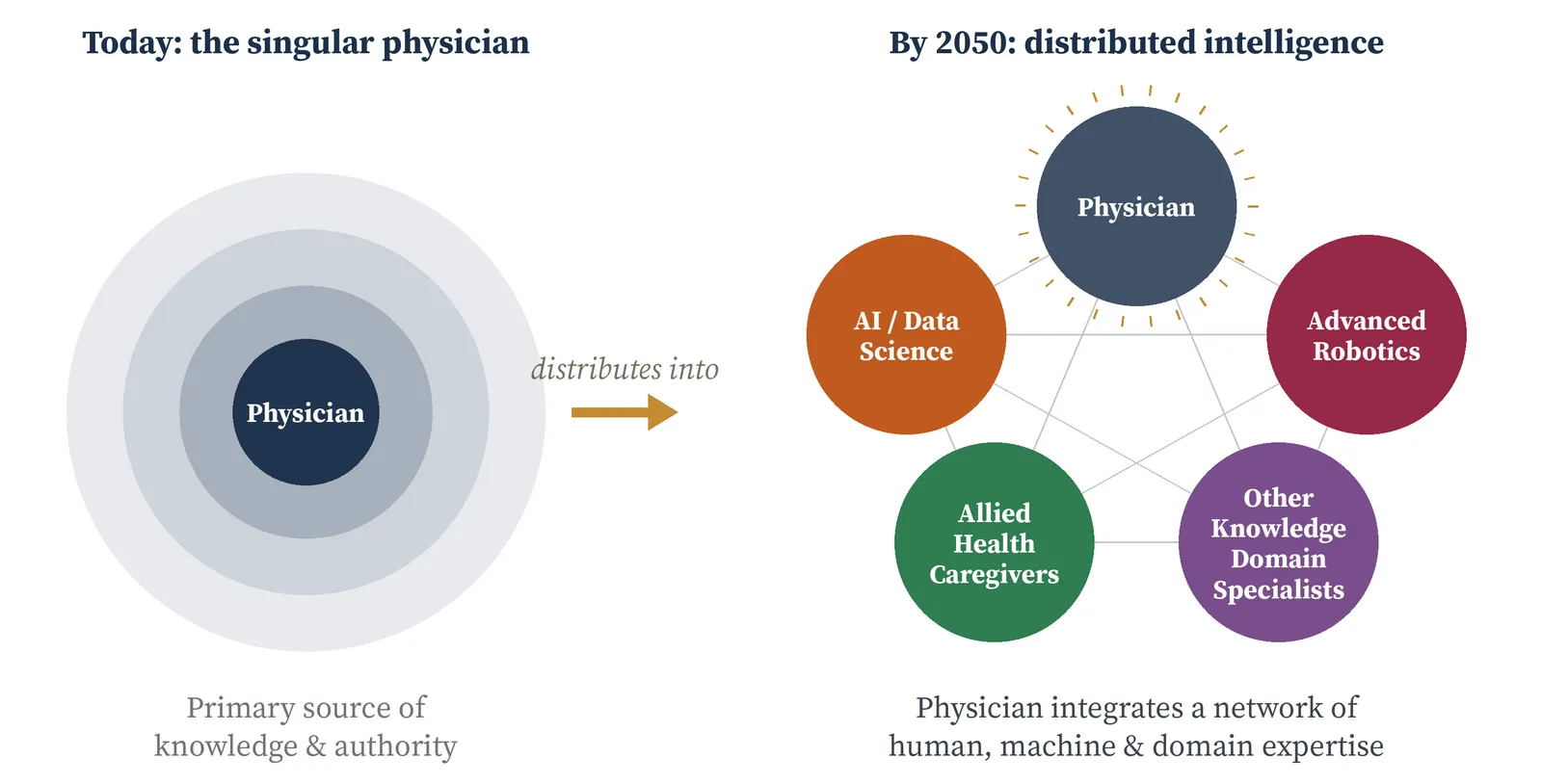
Exhibit 8.3 contrasts the two states directly. On the left, today's singular physician sits at the center of concentric rings as the primary source of knowledge and authority. On the right, by 2050, that monolith has distributed into a networked ensemble of physician, AI and data science, advanced robotics, allied health caregivers, and other knowledge-domain specialists, in which the physician integrates a network of human, machine, and domain expertise instead of containing it.
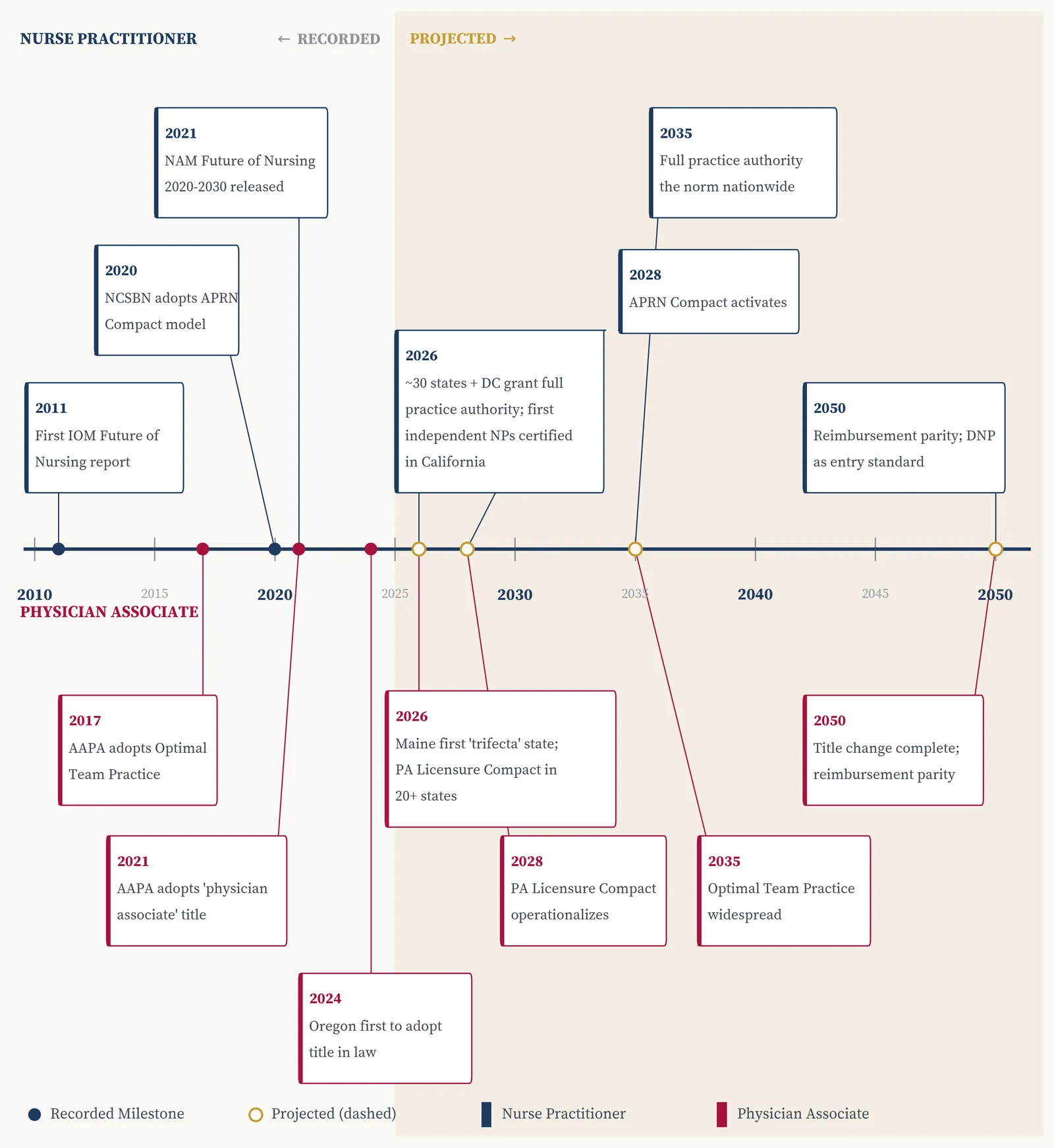
Exhibit 8.4 traces two parallel trajectories from 2010 to 2050, with recorded milestones giving way to projected ones.
The nurse practitioner road runs from the first Institute of Medicine Future of Nursing report in 2011, through the National Council of State Boards of Nursing's adoption of the APRN Compact model in 2020 and the National Academy of Medicine's Future of Nursing 2020-2030, to roughly thirty states and the District of Columbia granting full practice authority. Projected ahead: compact activation, full practice authority as the nationwide norm by around 2035, and reimbursement parity with the doctorate of nursing practice as entry standard by 2050.
The physician associate road runs from Optimal Team Practice in 2017, through the 2021 title change to physician associate and Oregon's adoption of it in law in 2024, to the PA Licensure Compact spreading across twenty or more states. It runs ahead to widespread Optimal Team Practice by around 2035 and completed title change with reimbursement parity by 2050.
Those two roads are the most visible. They are not the whole movement. Scopes of practice are expanding across most of the health professions at once. Pharmacists are the largest adjacent story: the push for federal provider status, payment mandates for pharmacist-provided services in most states, and advanced-practice licenses permitting independent initiation and adjustment of drug therapy, with test-to-treat, vaccination, and chronic disease management pointing toward pharmacists as front-line primary care extenders.44
Physical and occupational therapists have moved to direct access in most jurisdictions, with doctoral entry-level training and growing diagnostic and imaging-referral authority. Alongside them sit community health workers, formalized through certification tied to Medicaid reimbursement; community paramedics delivering in-home preventive care; and nurse anesthetists, nurse-midwives, and clinical nurse specialists on the same compact and full-practice-authority wave. The list continues with dental therapists, prescribing psychologists, anesthesiologist assistants, dietitians, respiratory therapists, speech-language pathologists, and genetic counselors, each facing the same shortage pressure pushing scope outward against organized resistance.44
Two extensions of that list matter. The first is lateral. A team of specialists means physicians and the mainstream allied health professions, physiotherapy and occupational therapy among them. It also means the emerging complementary professions, acupuncture and spiritual support among them, whose place in the trans- and interdisciplinary teams of the future follows directly from the holistic-integrative argument of Chapter V. A care model organized around the whole person cannot recognize only the practitioners its own history happens to have credentialed.
The second extension is forward, into professions that do not yet formally exist. Entirely new healthcare roles are likely to emerge around functions the current structure has no owner for: AI mediation, standing between clinical teams and the systems advising them; digital health stewardship, holding responsibility for the integrity of a person's data and devices over time; longitudinal patient navigation, carrying continuity across settings that no longer share a building; and virtual care coordination, running the encounter that has no address.
Each names work that is already being done badly by people whose job it is not. The professions that formalize it will be created within the horizon of this report, and the physician's relation to them will be settled early and then be difficult to revisit.
Such a system produces a patient-oriented team, with membership determined by what a particular person needs rather than by an institutional roster, assembled around them and dissolved when the need changes. Care becomes horizontal in exactly this sense. The orientation is toward the patient rather than toward the organization, which is why the composition cannot be fixed in advance.
One pattern runs through every category. Chronic workforce shortage, plus outcome data showing comparable results at lower cost, plus AI-enabled safety nets, is steadily shifting authority outward from a single physician to a distributed team. The third of those is least discussed and may prove most consequential. As AI provides a reliable second check on diagnosis and prescribing, it weakens the argument that mandatory physician oversight is what makes a decision safe, so machine intelligence may accelerate scope expansion more than any professional advocacy has.
That observation decides the ground on which scope will actually be argued. The profession's standard case for mandatory physician oversight has been that it catches errors, and a reliable machine check on diagnosis and prescribing takes that case away, since a system catching more errors more consistently is a better answer to the same question.
What remains is the claim the ledger of Chapter VI identified as durable, which is that someone must be answerable for the decision, able to say why it was made, and left carrying the consequence when it was wrong. That position is narrower than the one the profession has been defending, and it has the advantage of being true. A profession that keeps arguing error-catching will lose the argument on the evidence, and it will lose it to the machine rather than to another profession.
A working precedent already exists, in fields that sit at the periphery of professional prestige. Increased longevity and population aging, together with a growing emphasis on quality of life and on independence, are elevating rehabilitation, geriatrics, mental health, chronic disease management, and quality-of-life optimization from the periphery toward the center of what health systems actually do.
These are the least heroic domains in medicine and the most multidisciplinary. They are also, by virtue of that, the closest thing to a mature model of horizontal care that presently exists, and the attributes of the future physician as team member are visible in them today. They are the prototype rather than a lesser calling.
The redistribution has a direct consequence for what physicians do with the time it returns. Documentation, information retrieval, lower-level diagnostic work, and a share of procedural work move to other human or machine actors, which allows physicians to function increasingly at the top of their role, concentrating on complex judgment, coordination, ethics, compassion, the management of ambiguity, and longitudinal guidance. The arithmetic of practice changes with it. Doing less documentation and fewer low-level interventions, physicians can hold larger panels and supply more real-time feedback within them, which is the mechanism by which a smaller share of a physician's attention reaches a greater number of people without becoming thinner at each point.
Pushed to its limit, the principle dissolves the roster altogether. Care delivery becomes role-agnostic, organized dynamically around what a patient needs instead of around who is credentialed to supply it. Physician involvement occurs as required, not by default, and physician identity shifts from authority figure to orchestrator of distributed intelligence. That is a moonshot and should be treated as one. But the direction of travel toward it is already visible in every trend described here.
This is also where the collective intelligence literature of Chapter VI becomes operational. Recent work describes AI as augmenting three socio-cognitive pillars of a group: collective memory, the shared retrievable record; collective attention, focusing the team on signals that matter; and collective reasoning, the quality of deliberation, with AI functioning as infrastructure.44 A horizontal care team is precisely such a socio-technical architecture, and the design question is the one that literature keeps returning to. These systems succeed when the technology amplifies diversity and deliberation, and fail when it homogenizes them.
That function requires deep generalism, meaning sufficient depth across enough domains to recognize when a specialist recommendation is locally correct and globally wrong, and it requires cross-domain synthesis. The physician's role in horizontal models is therefore not to command every decision but to integrate, coordinate, escalate, and carry responsibility where medical judgment, ethical stakes, or complex synthesis require it. This demands humility and leadership at once.
That arithmetic has been offered before. Every technology of the past forty years that promised returned time delivered expanded expectation instead, the electronic record, the pager, the portal, and the message basket each absorbing the time it saved and then some, because time that is merely available is time that gets reallocated. No law of nature makes that cycle repeat, and no evidence yet shows it will not.
What would have to be true for this occasion to differ is that the returned time is protected by design, not merely freed. That means panel sizes set with the protected time already counted, visit lengths that do not contract to absorb the surplus, and expectations negotiated in advance instead of discovered afterward. Protection of that kind is a decision taken by whoever sets the schedule, which is why Chapter IX treats designed-in caring as a matter of architecture.
Notes
- 44National Academy of Medicine, The Future of Nursing 2020--2030: Charting a Path to Achieve Health Equity (2021); American Association of Nurse Practitioners, Full Practice Authority; American Academy of Physician Associates, Optimal Team Practice and the PA Licensure Compact; Thomas W. Malone and Anita Williams Woolley on collective intelligence, with Christoph Riedl and David De Cremer, "AI-enhanced collective intelligence" (2025) on collective memory, attention, and reasoning. On distributed cognition, Edwin Hutchins, Cognition in the Wild (Cambridge, MA: MIT Press, 1995). On the cephalopod nervous system, Natural History Museum (London), octopus neuroanatomy summary; Tamar Gutnick et al. on arm control and central connectivity; and a 2025 report in Nature Communications describing segmental organization of the axial nerve cord.
Ideas on this section
No ideas linked here yet. Propose an extension, a counterpoint, or a way to test a claim.
Discussion
Annotate this section — questions, counterpoints, references.
No comments yet. Start the thread.