Bridging Knowledge Domains: Consilience
One tension runs through this chapter: deep knowledge of a single domain against working knowledge of many, the specialist against the generalist. Physicianship has moved decisively toward the specialist.
One tension runs through this chapter: deep knowledge of a single domain against working knowledge of many, the specialist against the generalist. Physicianship has moved decisively toward the specialist. Flexner installed the scientific physician, and the century that followed subdivided that physician into specialties, subspecialties, and focused practice designations. The logic was sound. When the knowledge in a domain exceeds what one person can hold, the only way to hold any of it well is to hold less of it.
Scholarship outside medicine has examined what that bargain costs. Erik Dane's account of cognitive entrenchment describes how the schemas that make an expert fast and accurate become stable to the point of rigidity. Expertise thus buys performance within a domain at the price of flexibility across domains, loosened, he notes, by attention to tasks outside the domain rather than by more work inside it.
Robin Hogarth's distinction between kind and wicked learning environments explains when this matters: in kind environments, with stable rules and clean feedback, deep specialization compounds; in wicked ones experience can entrench the wrong lesson. Tetlock's study of expert prediction found much the same.40
The most useful distinction comes from Harry Collins and Robert Evans, who separate contributory expertise, the tacit skill needed to do the work of a specialty, from interactional expertise, full fluency in a domain's language acquired without the ability to practice it.40 Interactional expertise is a different and independently valuable capacity, not a lesser version of the real thing, and it makes conversation across a disciplinary boundary possible at all. It is also acquirable at a fraction of the cost. Much of what this chapter asks of the physician is interactional expertise held across many domains at once.
Two terms describe what results. The transdisciplinary physician operates across integrated domains rather than within one, holding enough of each to work at the joins. Distributed expertise describes the condition that makes such a physician necessary: the relevant knowledge is held across clinicians, AI systems, robotics, data infrastructures, and governance structures, and no participant holds enough of it to proceed alone.
Distributed expertise without a transdisciplinary physician is a set of specialists who cannot speak to one another. A transdisciplinary physician without distributed expertise is a generalist pretending to a depth nobody has.
The scholarship is not one-sided. Teodoridis, Bikard, and Vakili found that specialists outperform generalists precisely in fast-paced fields, where the cost of keeping up is high and focus is the only way to pay it.40 On that finding, accelerating biomedical knowledge argues for more specialization, which is exactly the logic the past century followed.
Machine intelligence changes a term in that equation. If the cost of keeping up is what forced specialization, and a machine now absorbs much of that cost, the balance shifts, and the biomedical literature has begun to say so. A recent analysis names the generalist-specialist paradox of medical AI: these systems already match or exceed specialists at bounded interpretive tasks while progressing far more slowly toward equivalence with generalists outside controlled settings, so the specialist's territory is the more automatable one.41
Kocher, Nolan-Mangini, and Wachter argue that by making specialist-level knowledge broadly available, AI dissolves the cognitive necessity that justified narrow specialty definitions, opening the way to a clinician organized around disease biology instead of organ boundary.41
A second reorganizing principle accompanies that one and cuts across it. AI performance is not evenly distributed across medicine, and the unevenness follows the structure of the problems rather than the boundaries of the specialties. Bounded, well-defined, data-rich areas advance quickly. Areas where problems are less structured, data weaker, and clinical situations less predictable remain dependent on human expertise.
Role variation may therefore increase. Some specialties will become deeply intertwined with AI systems and will require sophisticated oversight of computational tools; others will remain grounded in synthesis, ambiguity, and human interaction, and the competencies of the two will diverge. Pushed to its conclusion, the healthcare system reorganizes around what is and is not computationally tractable, producing AI-dominant and human-dominant domains with materially different staffing models, workflows, and physician expectations. That is a different cut through the specialties than disease biology, and it does not necessarily agree with it. What physicians will need in either case is a grasp of what AI can do, and of where it is reliable and where it should not be overextended.
The two principles need not be reconciled by choosing between them. Disease biology should govern where a boundary falls, because a specialty exists so that the clinician holding a patient holds a coherent object, and because computational tractability makes a poor border: what is tractable this decade is routine the next, and boundaries drawn around a moving line will need drawing again.
Tractability should instead govern the staffing model inside a boundary, deciding how much of the work is machine-performed and supervised, how much requires the specialist directly, and therefore what the training and the numbers should look like. Conflating the two produces the characteristic error of this period, which is redefining a clinical domain around what a model currently happens to do well.
The specialist does not thereby become unnecessary, since depth remains indispensable wherever the work is procedural, tacit, and embodied. What loses its justification is depth purchased as a substitute for breadth in roles whose real work is integration: the clinician holding the multimorbid patient, the escalation point in a distributed system, the person governing AI deployment, the one who must judge whether a specialist recommendation that is locally correct is globally wrong.
That physician, able to operate across disparate knowledge domains, integrate what they yield, and so heighten the capacity for judgment, ethical reasoning, and decision-making while holding the full diversity of dimensions of a particular patient in the N-of-1 mode of Chapter V, is the consilient physician. The word's etymology is relevant.
From the Latin con- (together) and salire (to leap), the word means literally a jumping together. The English polymath William Whewell coined it in 1840 in The Philosophy of the Inductive Sciences, describing the consilience of inductions in which an induction drawn from one class of facts unexpectedly coincides with one drawn from a wholly different class. For Whewell this was among the surest marks that a theory was true. E. O. Wilson revived the word in 1998, using it more expansively to argue that all domains of knowledge could be linked into a single coherent web of explanation.
Both senses are live in medicine, and both matter here.42
Exhibit 8.1 shows nine streams converging into a single coherent channel of understanding that in turn powers the consilient physician: complexity science, computation and AI, engineering and robotics, biomedicine, mathematics and probability, the humanities, socioeconomics, psychosocial science, and philosophy.
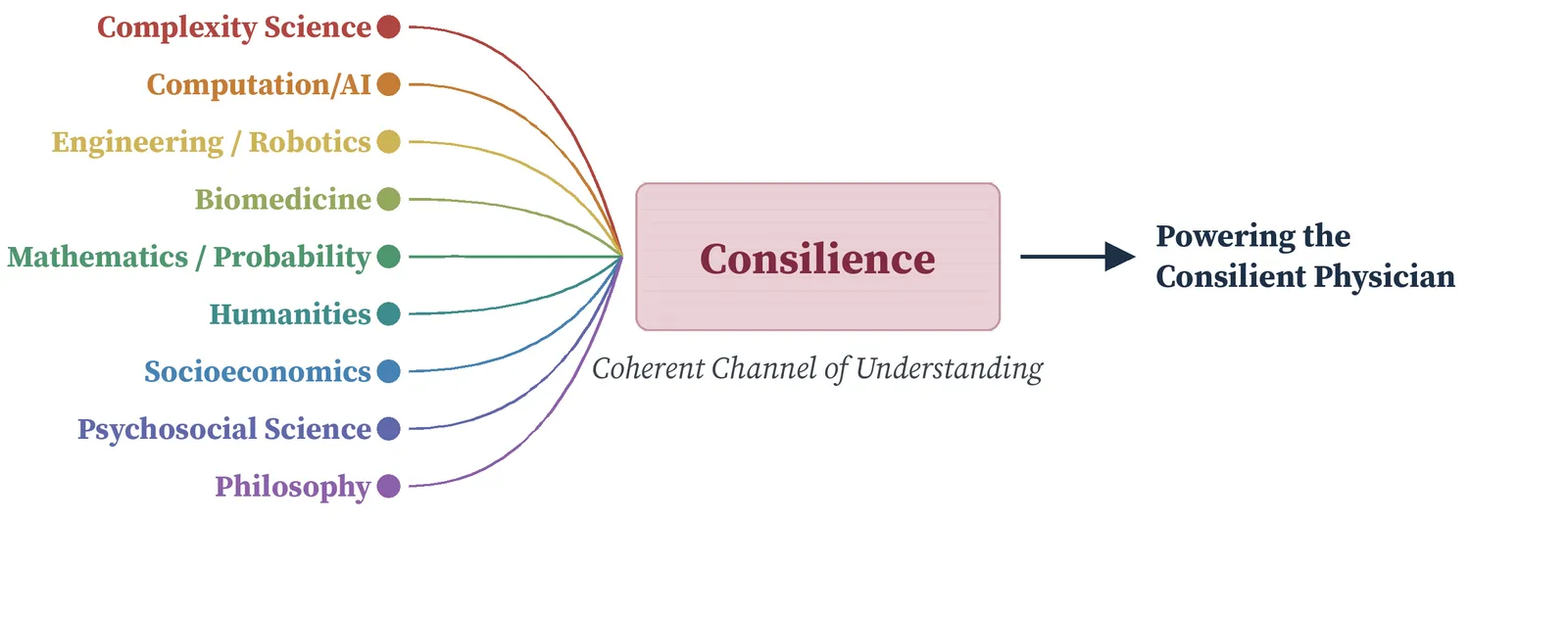
The physician is uniquely positioned to thread these together. Clinical work is the one activity that routinely requires all nine at once, on a single person, under time pressure, and requires them assembled into a coherent view rather than held side by side.
Threading nine domains together does not mean holding nine fluencies. Nobody holds interactional expertise in complexity science, robotics, socioeconomics, and philosophy at once, and a physician who claims it has usually acquired a vocabulary rather than a competence.
What the work requires is recognition: knowing which of the nine a problem actually belongs to, which is frequently not the one it presents as, and then acquiring enough fluency in that one to hold a productive exchange with someone who has depth. Recognition is a smaller skill than fluency and a rarer one, since it depends on having seen enough problems misfiled to know how misfiling happens. Acquisition on demand is the second half, and it is a claim about adaptability that Chapter XI has to make good on.
Seen from the patient's side, that convergence is care by connection: the reconnection of expertise, disciplines, and relationships around a whole person, and it states what consilience is for in terms a patient would recognize. It keeps two things joined that are easily separated: the intellectual work of unifying knowledge domains, and the relational work of reassembling a person whom specialization has parcelled out. A system can achieve the first and fail the second entirely, producing beautifully integrated knowledge about someone nobody is connected to.
The Back to Life Center at Sheba Medical Center, headed by Noya Shilo, was built for a clinical challenge that had almost no literature behind it: the long-term care of Israelis returned from captivity, together with their families and the families of those still waiting. The center convenes trauma medicine, psychiatry, pediatrics, neurology, social work, and spiritual care around a single family instead of routing each need to a separate clinic, on the premise that the injury is familial, not individual, and that survival alone is not the goal.
Its clinicians co-authored the Hostage-ReSPOND protocol, which deliberately placed holistic psychosocial intervention ahead of immediate medical workup, and the clinic has since followed close to a hundred patients under a commitment its director describes as lifelong.43 What makes it instructive is not the acuity of the cases but the architecture: a defined clinical problem that no single specialty could hold, answered by assembling the specialties around the person rather than distributing the person among them. Sheba has framed the model as exportable to hospitals facing hostage crises, war trauma, and humanitarian emergencies elsewhere, which is the test of whether consilience has been engineered or merely improvised.
The ability to bridge knowledge domains must come to be viewed as a core competency of the physician. And consilience must be engineered, not left to chance, hardwired into training, funding, and mentorship instead of left to serendipity.
Notes
- 40Erik Dane, "Reconsidering the trade-off between expertise and flexibility: a cognitive entrenchment perspective," Academy of Management Review 35, no. 4 (2010): 579--603; Harry Collins and Robert Evans, Rethinking Expertise (Chicago: University of Chicago Press, 2007); Robin M. Hogarth, Tomas Lejarraga, and Emre Soyer, "The two settings of kind and wicked learning environments," Current Directions in Psychological Science 24, no. 5 (2015): 379--385; Philip E. Tetlock, Expert Political Judgment (Princeton University Press, 2005); Florenta Teodoridis, Michaël Bikard, and Keyvan Vakili, "Creativity at the knowledge frontier: the impact of specialization in fast- and slow-paced domains," Administrative Science Quarterly 64, no. 4 (2019): 894--927.
- 41"The generalist--specialist paradox of medical AI," NEJM AI (2025); Bob Kocher, Siobhan Nolan-Mangini, and Robert M. Wachter, "How AI will redefine care delivery: the rise of the generalist-specialist," Health Affairs Scholar 4, no. 4 (2026): qxag075.
- 42William Whewell, The Philosophy of the Inductive Sciences (London, 1840); Edward O. Wilson, Consilience: The Unity of Knowledge (New York: Alfred A. Knopf, 1998).
- 43Naama de la Fontaine, Tamar Silberg, Jörg M. Fegert, et al., including Noya Shilo, “Acute response to the October 7th hostage release: rapid development and evaluation of the novel ReSPOND protocol implementation within a children’s hospital,” Child and Adolescent Psychiatry and Mental Health 18, no. 1 (2024): 76.
Ideas on this section (1)
- A shared-vocabulary box: convergence vs consilience
Readers outside the working group conflate the two. Worth a one-paragraph box early in Chapter I distinguishing the mechanism (convergence) from the working posture (transdisciplinarity) from the epistemic move (consilience).
FPI Editors · New · 0 comments
Discussion
Annotate this section — questions, counterpoints, references.
No comments yet. Start the thread.