Interprofessional Education: Reifying Consilience
The physician's function within distributed intelligence is to coordinate a widening spectrum of caregivers, partnering rather than directing, within a system whose other participants increasingly include machine intelligence and robotics. Interprofessional education is the road to that destination.
The physician's function within distributed intelligence is to coordinate a widening spectrum of caregivers, partnering rather than directing, within a system whose other participants increasingly include machine intelligence and robotics. Interprofessional education is the road to that destination.
Interprofessional education should be viewed as a core component of the educational program, not as a supplementary enhancement to physician training. Horizontal care and work in care teams, supplemented by humanoids, calls for its own set of competencies if it is to be performed well.
The field itself is in an unusually active phase. In 2023 the Interprofessional Education Collaborative released Version 3 of its Core Competencies, organizing thirty-three sub-competencies under values and ethics, roles and responsibilities, communication, and teams and teamwork.45 Publication volume has grown roughly twentyfold since 2000. Yet reviews continue to flag a weak evidential link between interprofessional education and measurable collaborative behavior or patient outcomes, which is the field's central problem.45
The weak evidence and the maturity ladder are probably the same finding stated twice. If nearly every studied program sits on the lowest rungs, then what the literature has tested is the weakest available version of the intervention: a shared lecture, an isolated workshop, an attitude survey administered afterward.
That such programs fail to shift behavior or outcomes is unsurprising, and it says little about interprofessional education conducted at the top of the ladder, which almost nobody has run long enough to study. The absence of evidence is a finding about implementation, not about the concept. It argues for building the higher rungs and measuring them, not for withholding commitment until evidence arrives that the current designs cannot produce.
Exhibit 8.5 sets out five rungs of maturity, and most institutions today sit on the first or the second.
Rung one, foundational. Ad hoc classroom events: one-off shared lectures and workshops, basic awareness of what other professions do, and assessment measuring attitudes, not behavior. Learners from different schools sit in the same room and then return to their silos. Better than nothing, and where most programs stop.
Rung two, structured. Curriculum-integrated simulation: competencies aligned to an explicit framework, recurring case-based team simulations in place of single events, and team skills formally assessed. The decisive change is recurrence: a competence practiced once is an experience, while one practiced repeatedly against feedback becomes a skill.
Rung three, technology-enabled. Immersive virtual reality and AI simulation: scalable AI virtual patients responding to questioning in real time, shared extended-reality clinics in which students from different schools or countries run a code together, and team digital twins built from simulation telemetry. This rung matters because it dissolves the constraint that has always limited the field, which is the impossibility of aligning the timetables of five professional schools.
Rung four, workplace-embedded. Practice as curriculum: learning inside real clinical microsystems across the whole career continuum and not only pre-licensure, with accountability shared between education and health-system leadership. The center of gravity moves from campus to ward, and practicing clinicians are included rather than treated as already formed.
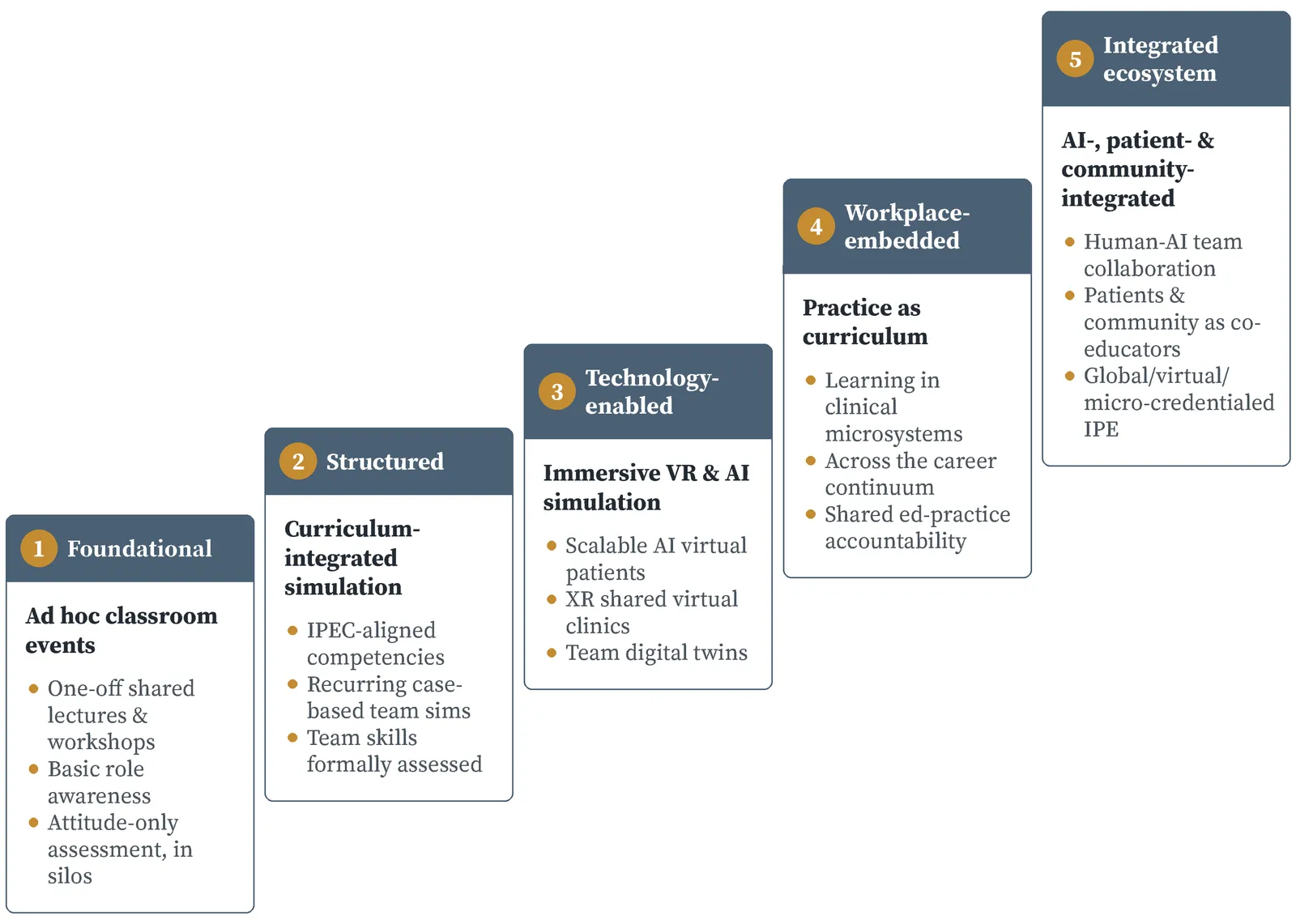
Rung five, integrated ecosystem. AI-, patient-, and community-integrated: human-AI teaming taught as a competence in its own right; patients and communities as co-educators who design and teach; and global, virtual, and micro-credentialed education extending into continuing professional development for teams already in practice. Here the curriculum finally matches the team Exhibit 8.3 describes.
Two cautions attach to the climb. The enablers at every rung are the same and rarely funded: faculty development and AI literacy, protected time and interoperable scheduling, sustained financing, and rigorous outcome measurement. And the recurring failure is doing the technology without the pedagogy, buying the virtual-reality suite and running the same one-off event inside it.
The optimal state is both didactic and experiential, sequenced so that didactic work establishes shared vocabulary, role understanding, and the mechanics of human-AI teaming. Experiential work then places learners in genuine interdependence, where the outcome depends on the team.
Beyond the Health Professions
One further extension is required. As currently used, interprofessional means the health professions: medicine, nursing, pharmacy, therapy, social work. That boundary made sense when the coordination problem sat inside the clinic, and it no longer does.
The physician described in this report will work alongside engineers and computer scientists building the systems, data scientists curating what those systems learn from, designers shaping the objects and interfaces of care, and architects shaping the spaces in which it happens. Lawyers and regulators will set the terms, financiers will decide what gets developed at all, ethicists and philosophers will frame what should be attempted, and humanists will supply the vocabulary in which any of it can be discussed with a patient.
If consilience is the intellectual claim of this chapter, then an education that reaches only the health professions reifies half of it. What is called for is better named trans-professional education: formation that puts physicians into genuine working interdependence with professions outside biomedicine altogether, on real problems, with shared accountability for the result. The Medicine + Design program described in Chapter VII is one working instance, pairing medical students with industrial designers and architects.
The principle generalizes. A trainee who has never had to persuade an engineer, or been corrected by a lawyer, or watched a designer reject a workable solution because it was ugly, will meet those professions for the first time in a setting where the stakes are that of the patient. The return on training environments of this kind is counted in decades rather than in course evaluations. People who train together go on to collaborate, to call one another, and to staff each other's projects, so a cohort formed across professions in its twenties is still working across them in its fifties, and a cohort formed inside one profession is not.
One further consequence of distribution concerns where care is delivered from, and it points away from consolidation. The technologies described in this report lower the infrastructure a physician needs in order to practice independently, which reverses a long trend in which health systems absorbed multi-physician practices because the capital requirements left little alternative. As the physician becomes a more augmented triage diagnostician, concierge roles and opportunities expand, and with them the prospect of localized augmented physician networks competing with conventional insurance-based arrangements on service and access.
Business models are outside this report's scope. The structural point is not. Distribution of intelligence permits distribution of practice, and where physicians choose to locate themselves within that possibility will shape how care is delivered as much as any technology named here.
Physicians have spent a century negotiating their terms with the entities that hold the capital, first hospital systems, then insurers, and now platform vendors. Distributed practice is the one scenario in which those terms could be set instead of negotiated, because a physician who does not require the capital does not require the counterparty. Whether the prospect is realized depends on decisions about infrastructure, data access, and reimbursement being taken now and mostly by others, which is the pattern Chapter I described. The point is not that every physician should practice independently. It is that a profession worried about being defined by others should notice where its leverage actually lies.
Bridging knowledge and bridging people are one competence applied at two scales, and trans-professional education is what happens when the second is taken as seriously as the first. The next identity concerns what neither can supply.
Notes
- 45Interprofessional Education Collaborative, Core Competencies for Interprofessional Collaborative Practice: Version 3 (2023); World Health Organization, Framework for Action on Interprofessional Education and Collaborative Practice (2010); National Academies of Sciences, Engineering, and Medicine, Measuring the Impact of Interprofessional Education on Collaborative Practice and Patient Outcomes (2015).
Chapter VIII recommendation
Recommendation. Cultivate consilience as a core physician competency rather than leaving it to chance. Restructure specialties deliberately, beginning with overlay specialties focused at first on cross-cutting knowledge domains at the technoscientific frontier, with boundary redrawing on a slower parallel track. Systematically enhance the distributed intelligence of horizontal care teams, factoring in the expanding scope of practice of other health professions. Elevate interprofessional education from supplementary enrichment to core curricular component. Abandon error-catching as the case for physician oversight, and instead, argue for answerability, as it is both narrower and truer. Place greater emphasis on working prototypes of optimized horizontal care, with rehabilitation, mental health, geriatrics, and chronic disease management among them. Explore affordable care models that optimize patient navigation and better integrate the patient experience across specialties, health professions, and other social sectors.
Ideas on this section
No ideas linked here yet. Propose an extension, a counterpoint, or a way to test a claim.
Discussion
Annotate this section — questions, counterpoints, references.
No comments yet. Start the thread.