Counterbalancing Specialty Fiefdoms
Specialties are the institutional form that knowledge domains take. A specialty is a boundary drawn around a body of knowledge, staffed, credentialed, reimbursed, and defended, and where those boundaries fall determines which connections are easy and which require crossing a border.
Specialties are the institutional form that knowledge domains take. A specialty is a boundary drawn around a body of knowledge, staffed, credentialed, reimbursed, and defended, and where those boundaries fall determines which connections are easy and which require crossing a border. Redrawing them is not an administrative exercise adjacent to consilience. It is consilience applied to structure: grouping knowledge domains so the combinations produce more coherent and more creative webs of explanation than those inherited from an earlier century.
Specialties and subspecialties have increasingly become fiefdoms. The barriers to change are formidable and well known: the existing infrastructure of specialists and their societies; the superstructure of graduate medical education pathways at residency and fellowship levels; and the accreditation and reaccreditation machinery. Each of these argues for stasis, and each is defended by people acting reasonably within their own frame.
Because each of those barriers can veto, the question is which move requires nobody's permission, and there is one. Redrawing a specialty boundary requires societies, training bodies, and accreditors to agree simultaneously, which is why it almost never happens outside a merger. Adding a competence that runs across specialties requires none of that, since it takes territory from no one and creates no new border to defend. The overlay specialty is therefore the tractable path, available now, and boundary redrawing is the slower parallel track that may follow once an overlay has demonstrated what the recombination is worth.
Beyond redrawing existing specialty lines lies the construction of hybrid roles and overlay specialties: configurations that integrate expertise across traditionally separate fields instead of partitioning a further one. An overlay specialty is not a subspecialty but runs across several, supplying a competence that each requires and none owns.
It is the natural institutional home for the domains this report keeps identifying as orphaned. Data science and complexity science are the obvious candidates, being specialty-agnostic in application and owned by no board, along with model governance, clinical robotics oversight, and the interpretation of continuous individual data. Configured as overlays, such competencies can be credentialed and staffed without waiting for the specialty structure beneath them to be redrawn.
Notwithstanding all of that, we must rethink the structure of specialties and subspecialties.
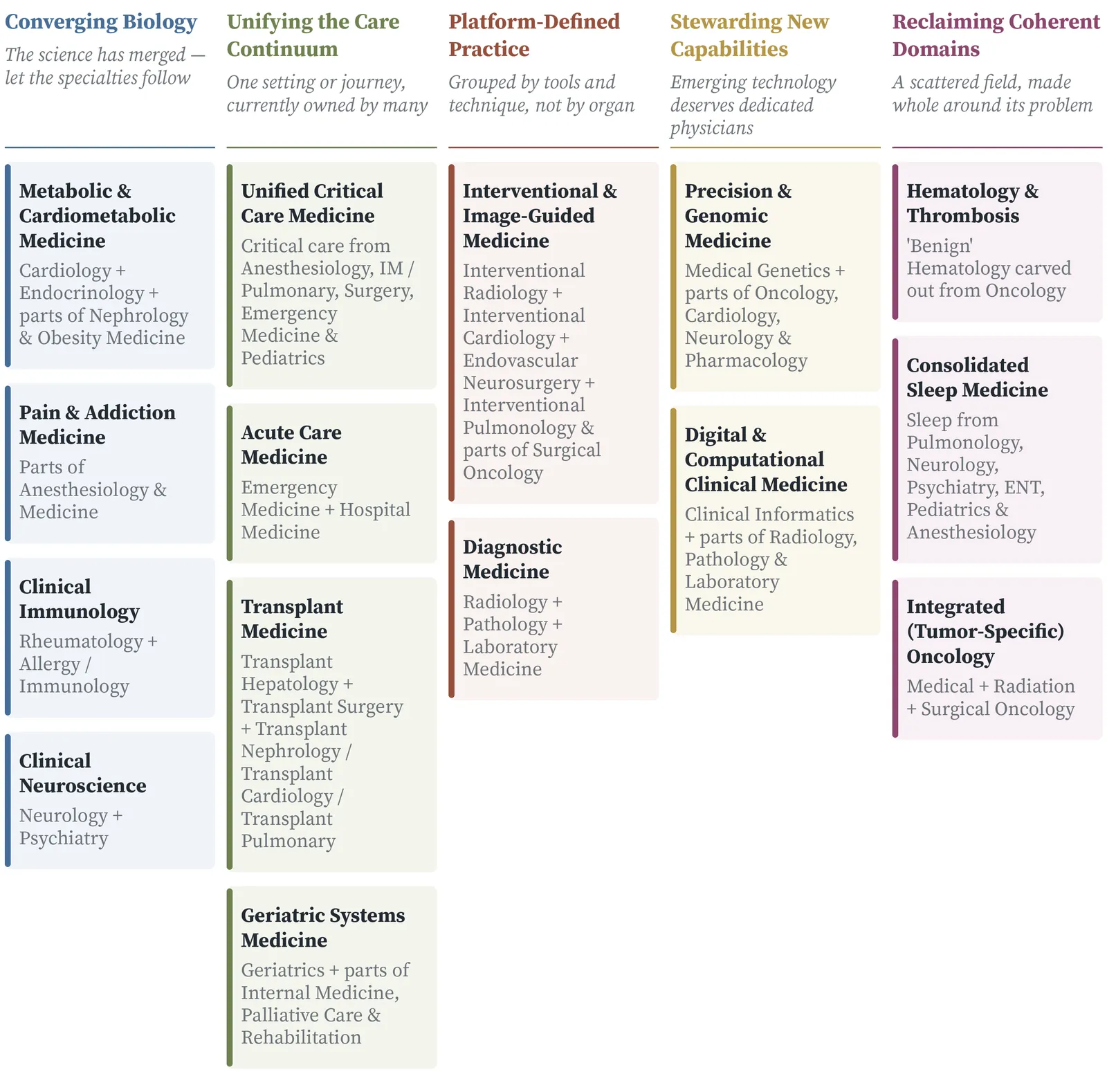
Three underlying reasons drive the case for revisiting the superstructure, and they underlie Exhibit 8.2. The first is converging biology: the science has merged where the specialties have not. The second is complexified technologies: whole classes of capability now cut across every organ boundary, among them catheter and image-guided intervention, genomic interpretation, and AI-augmented diagnosis, each demanding a technical depth no organ-based specialty can sustain as a sideline. The third is unifying the care continuum: a single setting or patient journey currently owned by many. The exhibit sorts the opportunities into five categories, taken here from left to right, each given with its candidates and then with one candidate carried through to its objections.
Converging biology. The science has merged; the specialties should follow. Four candidates sit here. Metabolic and cardiometabolic medicine would draw together cardiology, endocrinology, and parts of nephrology and obesity medicine around shared pathophysiology. Pain and addiction medicine would assemble from parts of anesthesiology and internal medicine. Clinical immunology would unite rheumatology with allergy and immunology. And clinical neuroscience would unite neurology and psychiatry around one organ currently managed by two workforces that barely overlap.
The pharmacology has already made the first case. Insulin resistance, adiposity, lipid handling, renal sodium handling, and vascular injury are one interacting system, and GLP-1 receptor agonists and SGLT2 inhibitors are simultaneously diabetes, heart failure, kidney, and obesity agents. The patient with one metabolic problem attends four clinics that reconcile their medications by letter. The barriers are heavy: four societies; four board pathways; four billing identities; and no agreement on who would own the patient afterwards.
Unifying the care continuum. One setting or journey, currently owned by many. Four candidates again. Unified critical care medicine would draw critical care from anesthesiology, internal medicine and pulmonary, surgery, emergency medicine, and pediatrics. Acute care medicine would join emergency and hospital medicine. Transplant medicine would consolidate a core across transplant hepatology, surgery, nephrology, cardiology, and pulmonary. Geriatric systems medicine would take geriatrics together with parts of internal medicine, palliative care, and rehabilitation, owning longitudinal care, deprescribing, and functional outcomes.
Critical care is the clearest example. The intensive care unit is a single setting with a single body of knowledge, entered today through five doorways each with its own certification and training sequence. A unified specialty would simplify staffing and standardize what an intensivist is taken to know. Against it: base-specialty identity runs deep; many intensivists depend on their parent discipline for the other half of their income; and asking five boards to cede a common core is a political problem, not an educational one.
Platform-defined practice. Grouped by tools and technique instead of by organ, this category holds two. Diagnostic medicine would consolidate radiology, pathology, and laboratory medicine into one interpretive discipline. Interventional and image-guided medicine would gather interventional radiology, interventional cardiology, endovascular neurosurgery, interventional pulmonology, and parts of surgical oncology.
It is the clearer illustration. Those five share their essential competence with each other rather than with their parent disciplines: catheter and wire skill, image guidance, radiation safety, device selection, and periprocedural management, currently taught four or five times over. Consolidation would concentrate procedural volume, which matters because volume and outcome are related, and let a hospital staff one interventional service instead of several thin ones. The objections are real. Organ-specific knowledge still matters at the moment of decision, and each parent specialty derives substantial revenue from these procedures, which makes this the category where turf is most explicit.
Stewarding new capabilities. Emerging technology requires dedicated physicians, and two candidates follow from that. Digital and computational clinical medicine would build from clinical informatics together with parts of radiology, pathology, and laboratory medicine. Precision and genomic medicine would draw medical genetics together with parts of oncology, cardiology, neurology, and pharmacology, and it shows the pattern most clearly.
Variant curation, penetrance estimation, pharmacogenomics, cascade testing, and the counselling that accompanies them constitute a distinct competence now required across every specialty and, in most places, performed by clinicians who acquired it informally. Concentrating it creates a genuine reference discipline. The risk cuts the other way: it could deskill everyone else at the moment genomics becomes routine, and medical genetics is a small, poorly reimbursed field to ask to absorb so large a remit.
Reclaiming coherent domains. A scattered field, made whole around its problem. Three candidates. Consolidated sleep medicine would gather sleep from pulmonology, neurology, psychiatry, otolaryngology, pediatrics, and anesthesiology. Integrated tumor-specific oncology would join medical, radiation, and surgical oncology around the tumor rather than the modality. And hematology and thrombosis would carve benign hematology back out from oncology, which is the case with the largest population behind it.
Thrombosis and anticoagulation, hemoglobinopathies, bone marrow failure, and bleeding disorders have been progressively crowded out inside combined hematology-oncology training, producing a workforce shortage in areas of very large need, and anticoagulation alone touches millions. Carving out a specialty around the problem instead of the cell line would rebuild the pipeline. Against it: the revenue asymmetry with oncology; a small trainee pool; and a prestige gradient decades in the making.
A sixth mode of restructuring belongs alongside these five, and it differs in kind, broadening the contour of a single specialty instead of recombining several. The clearest candidate is pathology transformed into a master technologist: expert and orchestrator of trans-specialty enabling technologies.
Pathology already sits where tissue, molecular data, laboratory data, and image analysis converge, and its practitioners are already among the profession's most experienced interpreters of machine-assisted image reading. Extended deliberately, the role becomes the institutional expert at an academic medical center for AI-augmented diagnostic interpretation across specialties, and for AI governance, model validation, provenance, drift monitoring, escalation thresholds, and adjudicating disagreement between systems.
The attraction of this route is that it requires no board to surrender anything. It expands a specialty into territory nobody occupies, and answers a question every health system is about to face: who, holding a medical license and accountable to patients, actually governs the diagnostic algorithms. The barriers are that pathology would have to train for competences it does not now teach, that the work is institutional rather than case-based and so fits current reimbursement poorly, and that other specialties may reasonably contest the claim. It is an example of the general move, and radiology, clinical pharmacology, and clinical informatics each admit versions of the same expansion.
Three rules follow for a trainee choosing a specialty. Favor competences that survive a boundary being redrawn: procedural skill that transfers; judgment about multimorbidity; the capacity to hold a patient nobody else can place. Treat overlay competences as insurance rather than as ornament, since a physician who can supervise a computational workflow or curate a variant is useful in whatever configuration emerges, and acquiring one costs a fraction of a second residency.
And plan on at least one boundary shift within a career, which means choosing a specialty for the work it contains rather than for the walls around it, since the walls are the part most likely to move. None of this argues against depth. It argues against depth chosen on the assumption that the territory is permanent.
Ideas on this section
No ideas linked here yet. Propose an extension, a counterpoint, or a way to test a claim.
Discussion
Annotate this section — questions, counterpoints, references.
No comments yet. Start the thread.